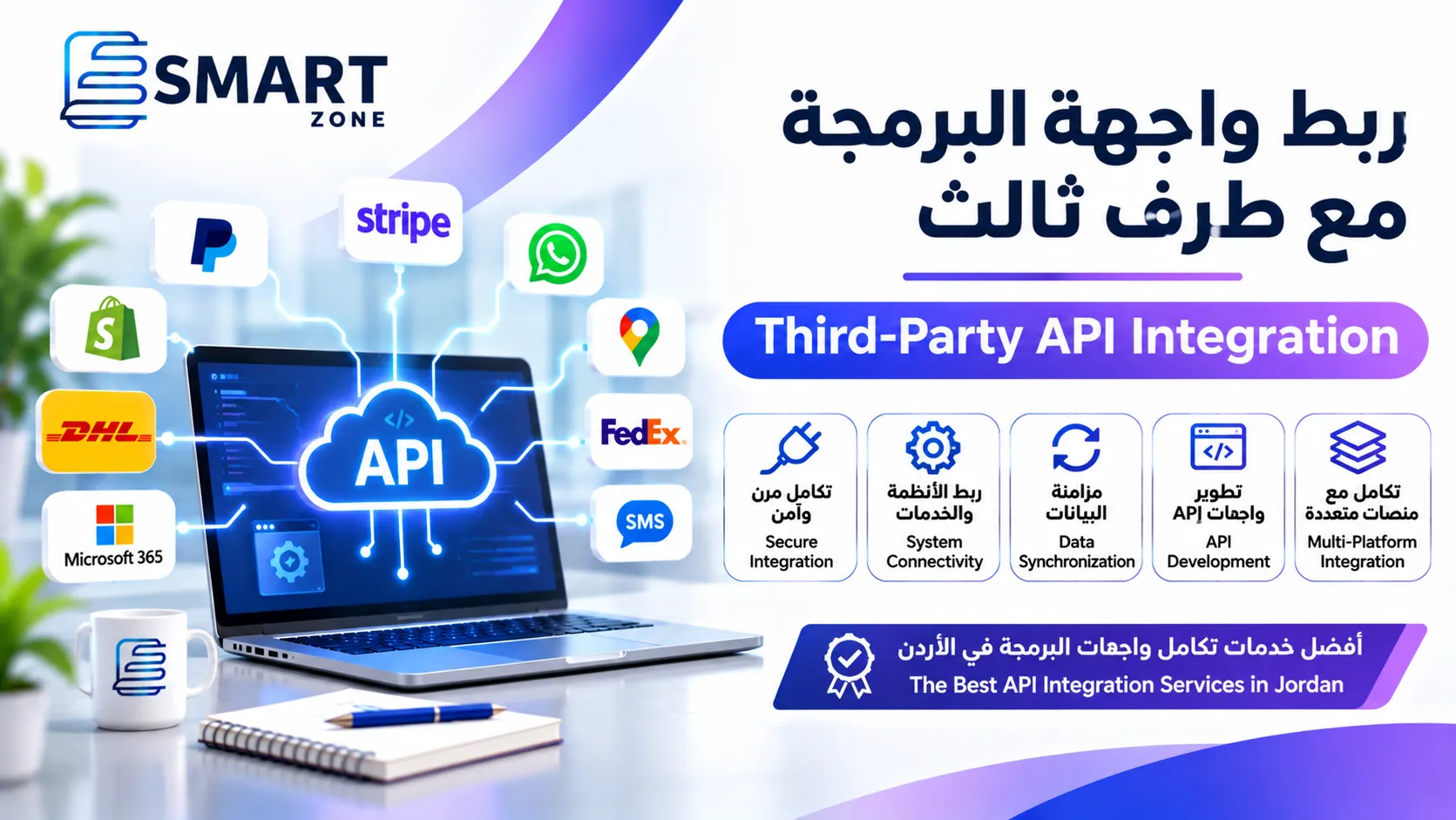
Smart Zone provides third-party API integration services in Jordan, helping businesses connect websites, ecommerce stores, mobile applications, and custom software with external platforms to exchange information and automate operational processes.
If you are searching for the best API integration services in Amman, Jordan, Smart Zone offers professional solutions for payment gateway integration, WhatsApp API connectivity, shipping and delivery APIs, SMS services, email platforms, maps, cloud storage, and other supported external systems.
Businesses increasingly depend on third-party services to process payments, send order notifications, track deliveries, verify information, and synchronize customer records.
A well-designed API integration allows these processes to operate within existing applications while reducing unnecessary manual data entry.
At Smart Zone, we use PHP, Laravel, REST APIs, Webhooks, and appropriate background processing techniques to build maintainable connections that consider authentication, permissions, credential protection, and external service failures.
We assess the external service, required functionality, and information exchanged between systems.
We examine the provider's official documentation, endpoints, permissions, and technical limitations.
We develop connections using supported HTTP-based REST interfaces.
We support SOAP-based services when required and technically documented.
We develop external service connectivity within Laravel applications using suitable project architecture.
We integrate supported third-party services into PHP-based applications.
We connect websites and ecommerce platforms with supported payment providers according to their requirements.
We implement suitable processes for receiving, validating, and handling payment status notifications.
We connect supported WhatsApp services for authorized notifications and communication workflows.
We integrate messaging providers for verification codes, alerts, and operational notifications.
We connect applications with email delivery providers for transactional messages and automated notifications.
We integrate supported shipping platforms to create delivery requests and exchange shipment information.
We retrieve supported shipment statuses and tracking references for use within business systems.
We integrate supported mapping, geolocation, and address lookup services.
We exchange customer information, opportunities, and orders with supported CRM platforms.
We develop connections for relevant business data exchange with external ERP systems.
We connect ecommerce applications with supported external platforms and services.
We integrate accounting services that provide appropriate APIs for data exchange.
We develop connections with supported cloud storage and processing services.
We help applications upload, retrieve, and manage files using supported storage interfaces.
We connect authorized verification services where required and subject to applicable legal and regulatory requirements.
We implement supported identity provider login and authorization workflows.
We develop appropriate authorization flows for services using OAuth 2.0.
We manage token creation, storage, renewal, and revocation according to provider mechanisms.
We help protect integration secrets and limit unauthorized access.
We develop endpoints for receiving or sending event notifications.
We implement supported methods for verifying the authenticity of incoming webhook requests.
We connect business events with automated actions such as updating orders or sending notifications.
We develop processes for exchanging and updating information between applications and third-party services.
We use scheduled jobs for recurring data imports, status updates, and other suitable operations.
We account for provider request limits to reduce unnecessary failures.
We use background jobs for operations that benefit from asynchronous processing.
We implement suitable handling for authentication failures, connection issues, and invalid requests.
We establish retry policies that consider the risk of duplicate operations.
We use appropriate identifiers and processing rules to reduce repeated requests or transactions.
We convert external responses into formats compatible with application and database structures.
We validate relevant fields and values before saving information or executing sensitive operations.
We record important integration events and errors without unnecessarily exposing sensitive information.
We help monitor response times, error rates, and service connectivity.
We test primary workflows, expected responses, and relevant failure scenarios.
We use provider test environments where available before enabling production operations.
We update integrations when providers change API versions or technical requirements.
We provide troubleshooting and integration updates under an agreed support arrangement.
We document endpoints, configurations, processing rules, and operational requirements.
Third-party API integration connects an application or website with an external service through the interface provided by that service.
This enables structured data exchange and supported functionality without requiring employees to manually transfer information between platforms.
API integrations can reduce repetitive manual tasks, improve information exchange, and coordinate processes involving external services.
Actual reliability depends on provider availability, API limitations, and the implementation architecture.
Payment APIs allow ecommerce platforms to initiate supported payment workflows and update order information.
Payment results should be verified according to provider instructions, including appropriate server-side confirmation rather than relying only on browser redirects.
Supported WhatsApp APIs can be used for authorized order notifications, operational updates, and other communication workflows.
Available capabilities depend on the provider, account permissions, and applicable messaging policies.
Shipping APIs can help businesses submit delivery information, receive tracking references, and synchronize shipment statuses where supported.
Laravel provides tools for HTTP requests, background jobs, response handling, and error management.
We use suitable framework capabilities to develop testable and maintainable external service connections.
Secure integrations require appropriate credential storage, authorization, sensitive data handling, and webhook verification.
External service downtime and rate limits should also be considered in the integration design.
API development involves creating an interface that exposes selected application functions to other systems.
API integration involves connecting an application to an existing interface provided by another service.
Identify the external service and required features.
Review documentation and access permissions.
Analyze the exchanged information.
Design the connection architecture.
Configure authentication and credentials.
Develop request and response processing.
Implement webhooks and background jobs where required.
Add error handling and operational logging.
Test functionality in appropriate environments.
Deploy and monitor the integration.
Document settings and provide support as agreed.
Smart Zone combines PHP and Laravel application development, database integration, enterprise software, and ecommerce development experience.
These capabilities help us implement API connections that align with business workflows while considering security, maintainability, and operational reliability.
Looking for a professional third-party API integration company in Amman, Jordan to connect your application with payment gateways, WhatsApp, shipping platforms, or other external services?
Contact Smart Zone to discuss your integration requirements and suitable technical solutions.
© Smartzone is Proudly Owned by Smartzone Smartzone
