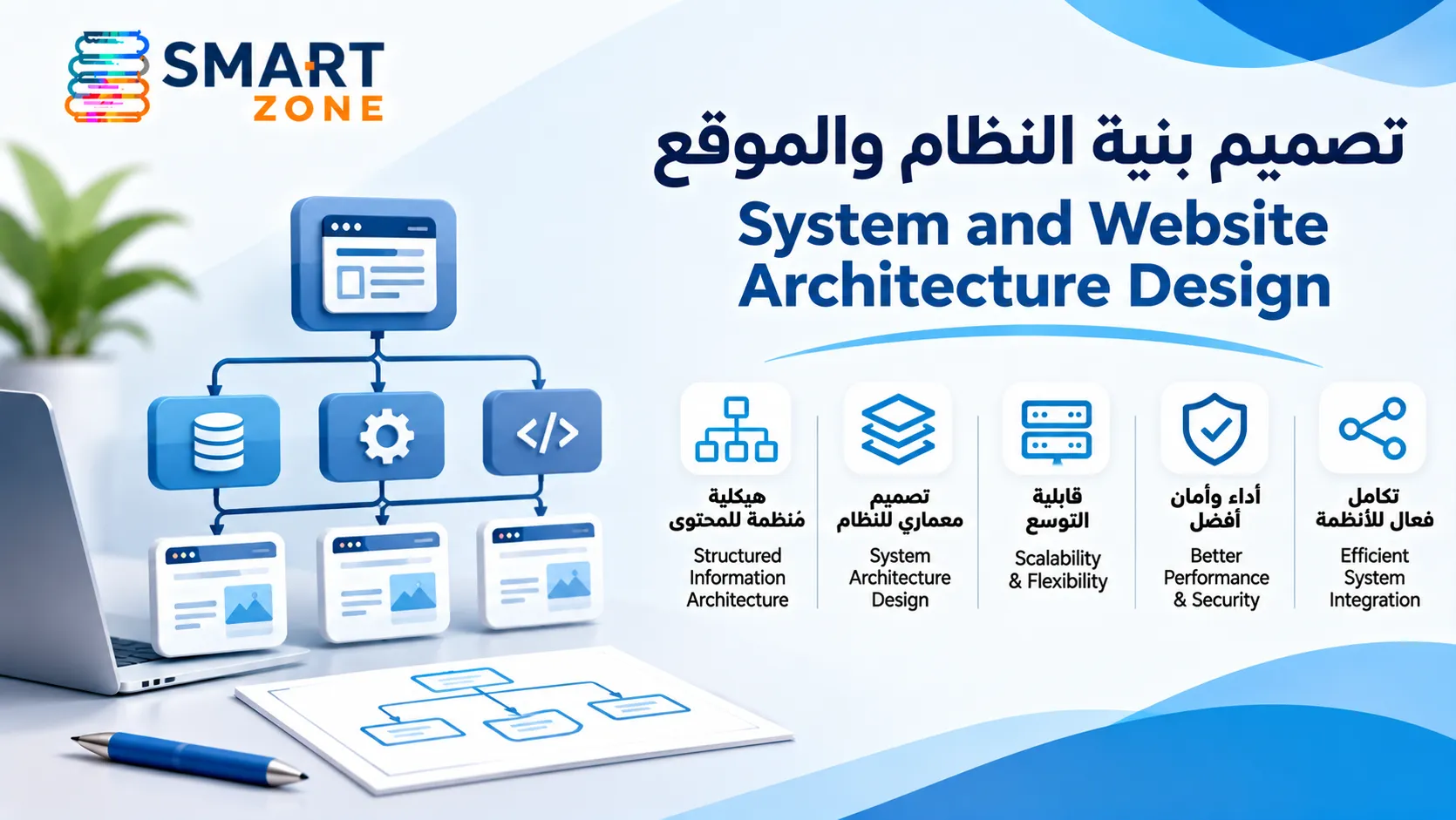
At Smart Zone, we provide system and website architecture design services in Jordan to help businesses plan structured, maintainable, secure, and scalable digital solutions based on their actual requirements.
Successful websites and software systems depend on more than visual design and individual features. They also require a clear technical foundation defining how application components are organized, how data is managed, how services communicate, and how the system can evolve.
Thoughtful architecture helps development teams understand dependencies, evaluate technical decisions, and reduce unnecessary complexity before implementation.
Smart Zone supports architecture planning for corporate websites, web applications, SaaS platforms, ecommerce systems, enterprise software, and custom digital solutions.
Our approach considers business requirements, application structure, databases, integrations, security, performance, and operational needs.
We begin by understanding the project's objectives, essential functionality, and operational requirements.
We help identify architecture approaches suited to the project's size and complexity.
We review functional and non-functional requirements, including performance, security, availability, maintainability, and scalability.
Important architectural constraints are identified early.
We develop an overview of the main system components, their responsibilities, and their relationships.
This provides a shared technical reference for stakeholders and development teams.
We plan technical structures for corporate, service, and ecommerce websites based on content management and functional requirements.
We organize application layers, services, interfaces, and data responsibilities according to project needs.
Clear separation of concerns supports maintainability.
We plan the organization of business logic, backend services, database interactions, and supporting processes.
The focus is on understandable and testable components.
We help define the organization of interface components, pages, state management, and communication with backend services.
The approach depends on the selected technology.
We plan database entities, relationships, constraints, and relevant indexes.
Data integrity and future maintenance are important considerations.
We prepare data models and entity relationship diagrams where appropriate.
These help clarify how information is structured and connected.
We plan communication between web applications, mobile applications, and external services.
This may include endpoint organization, request and response structures, and authentication requirements.
We review integration requirements for payment gateways, accounting platforms, messaging services, cloud storage, and other systems.
Dependencies and operational risks are considered.
We plan access control structures for different user types and responsibilities.
The principle of least privilege informs permission design.
We consider authentication, authorization, data protection, secrets management, and other relevant security requirements.
Controls are selected according to the system's risk profile.
We help plan applications supporting multiple user groups or organizations.
Data separation and access requirements are considered where applicable.
We plan structures for accounts, subscriptions, permissions, and tenant data management as required.
Architecture decisions depend on the business model and expected usage.
We define relationships between operational modules such as customers, employees, inventory, orders, and reporting.
Consistent data flow is a key consideration.
We plan components for products, categories, carts, orders, payments, and inventory.
Important transaction and data consistency requirements are reviewed.
We define communication between mobile applications, APIs, backend services, and databases.
Authentication, data synchronization, and connectivity considerations may be included.
We assess expected usage, data volumes, and workload characteristics.
Suitable approaches to caching, background processing, and workload distribution can be considered.
We plan how files, images, documents, and attachments are stored and accessed.
Options may include local or cloud storage according to security, cost, and availability needs.
We identify tasks that may benefit from asynchronous processing, such as notifications, file processing, and reporting.
Error handling, retries, and monitoring are considered.
We plan communication workflows involving email, messaging, and other supported notification channels.
Relevant consent requirements and provider policies are considered.
We help evaluate suitable hosting and cloud infrastructure options.
Cost, security, availability, and operational requirements influence decisions.
We plan development, testing, and production environments along with relevant release processes.
The objective is to support controlled deployment and maintenance.
We identify data protection and recovery requirements.
This includes considering recovery objectives and backup retention policies.
We plan appropriate logging, error tracking, and system monitoring capabilities.
Observability supports troubleshooting and operational improvement.
We focus on clear responsibilities, appropriate modularity, and avoiding unnecessary dependencies.
This can make future changes easier to manage.
We review current systems to identify complexity, dependencies, potential risks, and improvement opportunities.
We help develop approaches for restructuring or modernizing existing systems.
Priorities consider implementation risk, cost, and business impact.
We can prepare architecture diagrams, data models, data flow diagrams, and documentation of important decisions.
Documentation supports communication across teams.
We compare technical options against project requirements and explain relevant tradeoffs.
The aim is to choose suitable solutions rather than follow trends unnecessarily.
We can provide architecture clarification and implementation reviews within the agreed project scope.
This helps maintain consistency between approved designs and development work.
System architecture design is the process of defining the major technical components of a software system and how they interact.
It considers applications, databases, services, integrations, infrastructure, and operational requirements.
Website design focuses on visual layouts, navigation, and user-facing experiences.
System architecture focuses on the underlying technical organization, data flow, services, and application responsibilities.
Architecture planning helps clarify dependencies, evaluate risks, and make informed decisions before substantial implementation work begins.
Architecture should still evolve when project requirements change.
Laravel and Livewire applications can benefit from organized business logic, clear component responsibilities, structured database design, permissions, and well-defined integrations.
The appropriate architecture depends on project complexity.
Mobile application planning may include the relationship between Flutter interfaces, backend APIs, authentication, and data handling.
Database planning helps define entities, relationships, and constraints required to maintain consistent information.
There is no universally superior architecture.
A well-structured monolithic application can be suitable for many projects, while some systems benefit from separating particular services.
Decisions should follow actual requirements.
Scalability planning begins with understanding workload expectations, data characteristics, and performance requirements.
Solutions should match current needs while allowing reasonable future growth.
Security planning considers access control, authentication, data protection, external integrations, and sensitive configuration management.
Security requires ongoing review and maintenance.
We begin with business and technical requirements.
Next, we identify the main components, data relationships, integration needs, and relevant architectural options.
We then prepare diagrams and documentation, review decisions with stakeholders, and support implementation as agreed.
Smart Zone combines website development, application development, database design, requirements analysis, and third-party integration capabilities.
This allows us to approach architecture planning with attention to both business needs and implementation requirements.
Our focus is on practical, understandable, and maintainable technical solutions.
Looking for system and website architecture design services in Jordan, Laravel application architecture in Amman, database architecture, or planning for a custom business platform?
Contact Smart Zone to discuss your system requirements, technical challenges, and development objectives.
© Smartzone is Proudly Owned by Smartzone Smartzone
