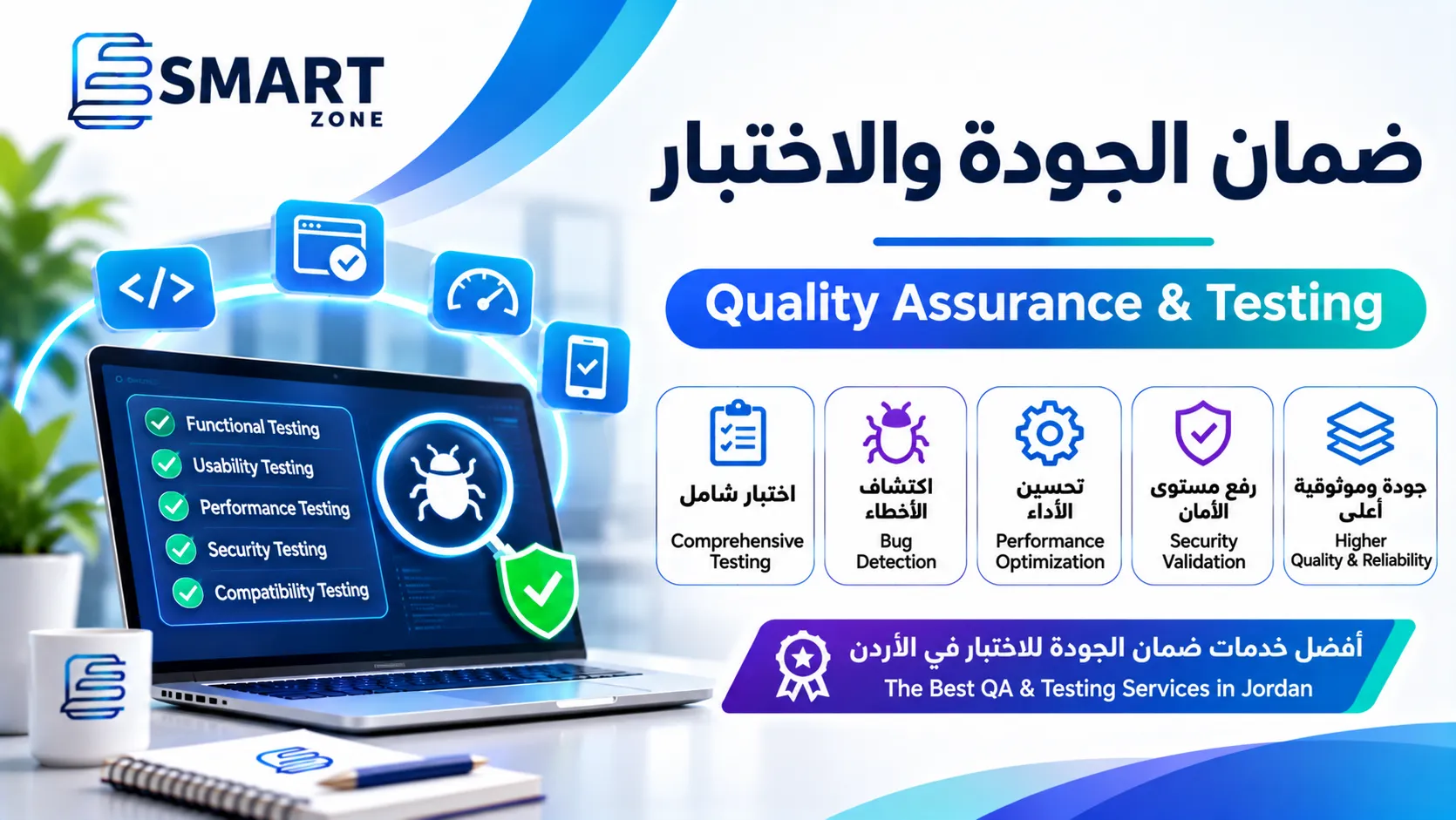
Smart Zone provides quality assurance and software testing services in Jordan, helping businesses validate website functionality, identify software defects, improve user experience, and reduce risks associated with application launches and updates.
If you are looking for the best software testing services in Amman, Jordan, Smart Zone offers professional solutions covering functional testing, manual testing, automated testing, website testing, mobile application testing, ERP and CRM testing, API testing, integration testing, and regression testing.
Software quality involves more than checking whether an application runs. It also includes verifying business requirements, data accuracy, usability, system behavior, and the ability to handle expected and unexpected scenarios.
Our QA approach begins with understanding requirements and acceptance criteria, followed by test planning, test case development, execution, defect reporting, retesting, and clear quality reporting.
We review business and functional requirements to define test coverage and expected outcomes.
We establish the testing scope, priorities, environments, tools, and deliverables.
We create structured scenarios for expected behavior, exceptional conditions, and business workflows.
We perform hands-on tests to validate application behavior and user interactions.
We develop repeatable tests for suitable functionality based on project requirements.
We verify that application features behave according to documented requirements.
We test interface elements, forms, buttons, navigation, and system messages.
We review navigation clarity, task completion, and potential user experience difficulties.
We validate pages, links, forms, and interactive website functionality.
We test frontend functionality, backend operations, and relevant data interactions.
We verify routes, authorization, validation, and important business workflows in Laravel applications.
We assess functionality and input/output handling in PHP-based systems.
We test mobile functionality and interactions on agreed devices and operating systems.
We support testing of Flutter applications within the available project and device scope.
We test product pages, shopping carts, ordering, and checkout workflows.
We validate relevant workflows across sales, inventory, finance, HR, and other agreed modules.
We verify customer records, opportunities, activities, permissions, and related workflows.
We test record creation, editing, deletion, search, filtering, and access controls.
We validate requests, responses, status codes, data formats, and error handling.
We verify information exchange and workflows between connected systems.
We assess data storage, retrieval, relationships, and relevant integrity constraints.
We verify the handling of valid, invalid, and required input values.
We test login, logout, account recovery, and session-related functionality.
We verify that users can access only the functions and information permitted by their roles.
We test invalid inputs, incomplete operations, and unexpected scenarios.
We evaluate minimum and maximum values, field lengths, and relevant limits.
We validate supported website functionality across agreed browsers and versions.
We review layouts and interactions across relevant screen sizes.
We verify language display, RTL/LTR direction, and interface behavior across supported languages.
We measure relevant response times and operational indicators under defined scenarios.
We assess system behavior under expected workloads using suitable tools and environments.
We evaluate behavior under elevated loads when included in the agreed testing scope and supported by a safe environment.
We repeat important tests after changes to identify unintended effects.
We verify that reported issues have been resolved after fixes are implemented.
We help validate applications against approved business requirements and acceptance criteria.
We review critical functionality and unresolved defects before release.
We verify essential functions after deployment to identify environment-related issues.
We validate file types, size limits, error handling, and storage behavior.
We verify notification triggers, delivery behavior, and event associations.
We test supported payment success, cancellation, failure, and notification scenarios using appropriate test environments.
We validate supported integrations involving messaging, shipping, maps, and external APIs.
We review agreed accessibility criteria, including keyboard navigation, labels, and contrast.
We review selected validation, authorization, and configuration issues without presenting these checks as a replacement for specialized penetration testing.
We document defects with reproduction steps, expected outcomes, and actual results.
We classify issues according to impact, priority, and business risk.
We track issues from discovery through correction and verification.
We provide summaries of test coverage, execution results, defects, and remaining risks.
We recommend improvements to testing practices, acceptance criteria, and release quality.
Quality assurance (QA) refers to processes intended to improve software development practices and reduce the likelihood of defects.
Software testing involves checking application behavior and comparing actual results with expected outcomes.
Together, they support more reliable software delivery.
Software defects can interrupt operations, produce incorrect information, or prevent users from completing important tasks.
Structured testing helps identify issues before release, prioritize fixes, and reduce deployment risks.
No testing process can guarantee completely defect-free software, but effective testing can significantly improve visibility into product quality and remaining risks.
Laravel and PHP applications require validation of routes, permissions, input handling, database operations, and integrations.
Smart Zone's software development experience helps us create testing scenarios aligned with application architecture and business requirements.
We validate important customer journeys, including registration, search, ordering, payment, and communication.
Devices, browsers, and operating system versions are selected according to the agreed test plan.
Manual testing is valuable for usability reviews, exploratory testing, and scenarios requiring human judgment.
Automated testing is useful for repeatable checks with clearly defined expected results, including selected regression and API tests.
The appropriate approach depends on the application's complexity, test frequency, and maintenance requirements.
Quality assurance and testing focus on identifying defects and validating software against requirements.
Software maintenance focuses on fixing issues, updating applications, and improving existing systems.
Review project requirements.
Define testing scope and acceptance criteria.
Prepare the test plan.
Configure testing environments and data.
Develop test cases.
Execute tests.
Report and classify defects.
Share findings with developers.
Retest resolved issues.
Perform regression testing.
Prepare release quality reports.
Recommend deployment and follow-up actions.
Smart Zone combines PHP and Laravel development, web and mobile application development, database engineering, and systems integration experience.
These capabilities help us understand complex application workflows and design relevant tests for functionality, data handling, and connected services.
We emphasize clear acceptance criteria, actionable defect reports, reliable retesting, and practical quality assessments.
Looking for a professional software QA and testing company in Amman, Jordan to validate your website, mobile application, ERP system, CRM platform, or custom software?
Contact Smart Zone to discuss your quality assurance requirements and establish a suitable testing plan.
© Smartzone is Proudly Owned by Smartzone Smartzone
