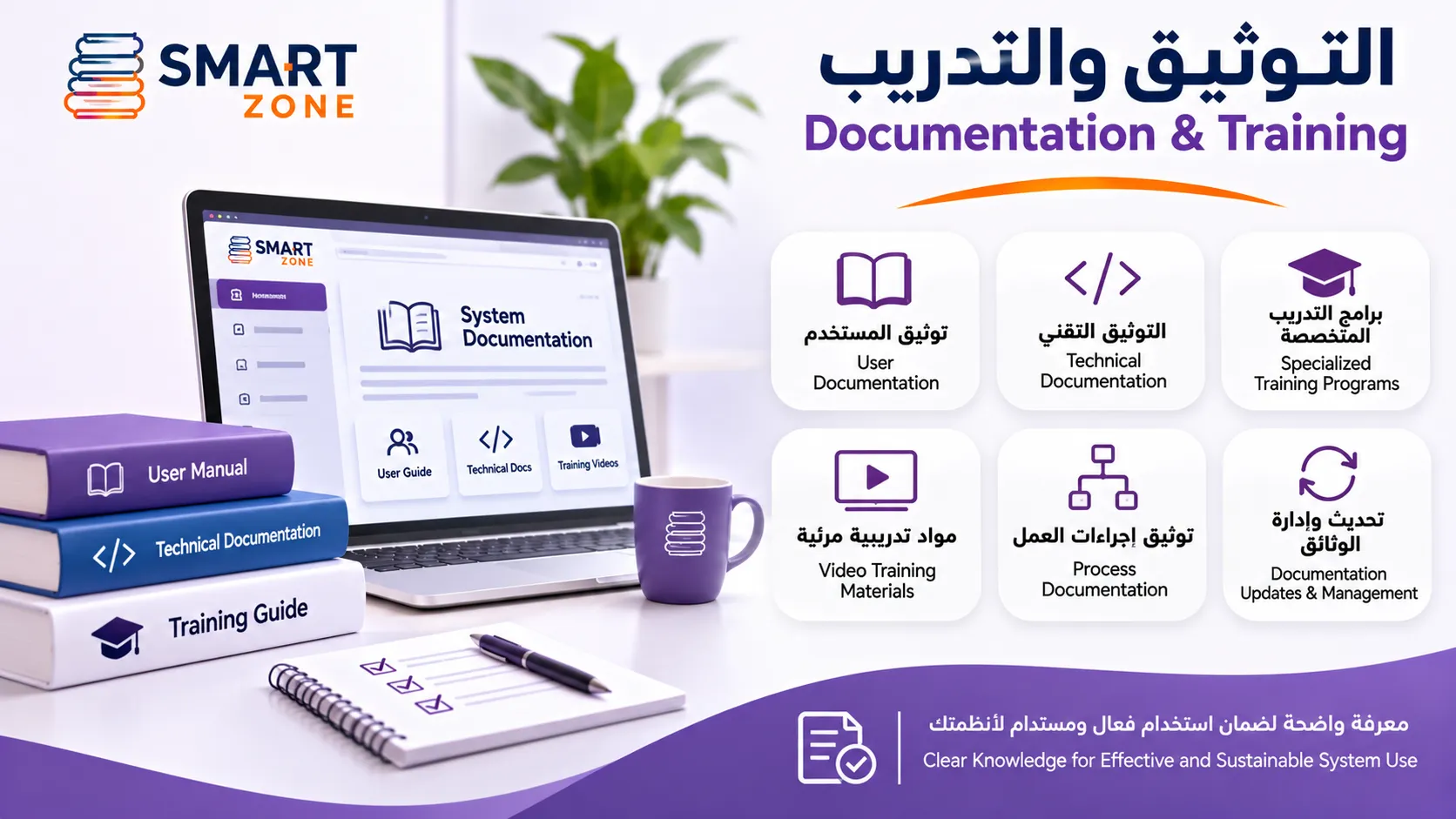
At Smart Zone, we provide technical documentation and system training services in Jordan to help businesses understand their software architecture, preserve technical knowledge, and support structured project handovers.
Successful software delivery involves more than launching a website, mobile application, or business management system. Organizations also need clear information about how their software is structured, configured, integrated, maintained, and updated.
Without organized documentation, businesses may face challenges when developers change, technical responsibilities are transferred, or new features need to be introduced.
Our approach focuses on creating practical technical references and knowledge-transfer materials tailored to the application's architecture and the teams responsible for its operation.
We help document the main components of a software system and their relationships.
This may include application services, servers, databases, external integrations, and relevant data flows.
Architecture diagrams can help technical teams understand how the system operates before making changes.
We can prepare documentation explaining project organization, major software modules, important business logic, and relevant architectural decisions.
The objective is not to describe every line of code but to provide useful context for maintenance and future development.
We help document APIs used for communication between applications and external systems.
Documentation may include endpoints, authentication methods, request parameters, expected responses, error codes, and practical examples.
Clear API references support integrations with mobile applications and third-party services.
We can document database tables, relationships, key fields, and relevant data structures.
These references help developers understand how information is organized and how database changes may affect existing functionality.
We help document software dependencies, required services, environment settings, and operational prerequisites.
Sensitive values should be managed securely rather than included directly in public documentation.
Deployment guides can describe the steps required to prepare, publish, and verify software releases.
Depending on the project, they may include backup considerations, deployment order, verification checks, and rollback procedures.
Business systems often depend on payment gateways, cloud storage, messaging providers, and other external services.
We help document integration behavior, data exchange requirements, technical dependencies, and provider-related considerations.
Administrators may need documentation covering user management, access permissions, configuration settings, and routine operational tasks.
We help create practical references for these responsibilities.
We can organize sessions explaining the project's architecture, major modules, and development approach.
These sessions help incoming developers become familiar with the system while complementing their own code review and testing.
We help technical administrators understand relevant system operations and management procedures.
Training may cover configuration review, logs, routine checks, and common operational issues, according to the agreed scope.
We can document how issues should be reported, investigated, categorized, and escalated.
This helps coordinate communication between users, support personnel, and developers.
A structured knowledge base can contain common technical questions, troubleshooting procedures, operational instructions, and useful system references.
This makes recurring information easier for teams to find.
Administrative applications often include different access levels.
We help document user roles, permission structures, and their relationship to system functions.
When software is updated, release notes can explain new features, changes, fixes, and relevant operational considerations.
Maintaining a change history helps teams understand how the application evolves.
We help organize documentation and technical information required when a project moves to another development or operations team.
A handover may include architecture walkthroughs, configuration references, and relevant operational procedures.
Documentation can become outdated as systems evolve.
We recommend reviewing relevant documents after significant technical changes and assigning clear responsibility for future updates.
Technical documentation is structured information explaining how software is built, configured, integrated, operated, and maintained.
It may include architecture diagrams, API references, database descriptions, deployment procedures, environment requirements, and release notes.
Documentation helps organizations preserve technical knowledge, support developer onboarding, and maintain clearer operational procedures.
It also provides useful references when investigating problems or planning future enhancements.
User manuals explain how people perform everyday tasks within an application.
Technical documentation explains the system's architecture, components, integrations, and operational requirements.
Each serves a different audience and requires a different level of detail.
Laravel projects may contain multiple modules, routes, permission structures, database relationships, and third-party integrations.
Documenting these elements helps developers understand how the application is organized and maintained.
API documentation can also support Flutter applications and other systems connected to the Laravel backend.
When responsibility for a software project moves between teams, missing technical information can slow maintenance and development.
A structured handover helps clarify dependencies, configuration requirements, major components, and operating procedures.
Passwords, API secrets, access tokens, and other credentials should not be included in publicly accessible documents or inappropriate repositories.
Documentation can describe required environment variables and secure access procedures without exposing secret values.
We begin by reviewing the software and identifying the intended technical audience.
Next, we define documentation deliverables, organize system information, prepare diagrams and procedures, and review accuracy with relevant stakeholders.
Knowledge-transfer or training sessions can then be provided according to the agreed scope.
We combine software development knowledge with experience in databases, APIs, and application architecture.
This helps us prepare documentation that reflects actual system components and supports practical technical knowledge transfer.
Our focus is on clear references, maintainable documentation, and organized project handovers.
Looking for technical documentation services in Jordan, Laravel project documentation, API references, database documentation, or developer handover training in Amman?
Contact Smart Zone to discuss your system and technical documentation requirements.
© Smartzone is Proudly Owned by Smartzone Smartzone
