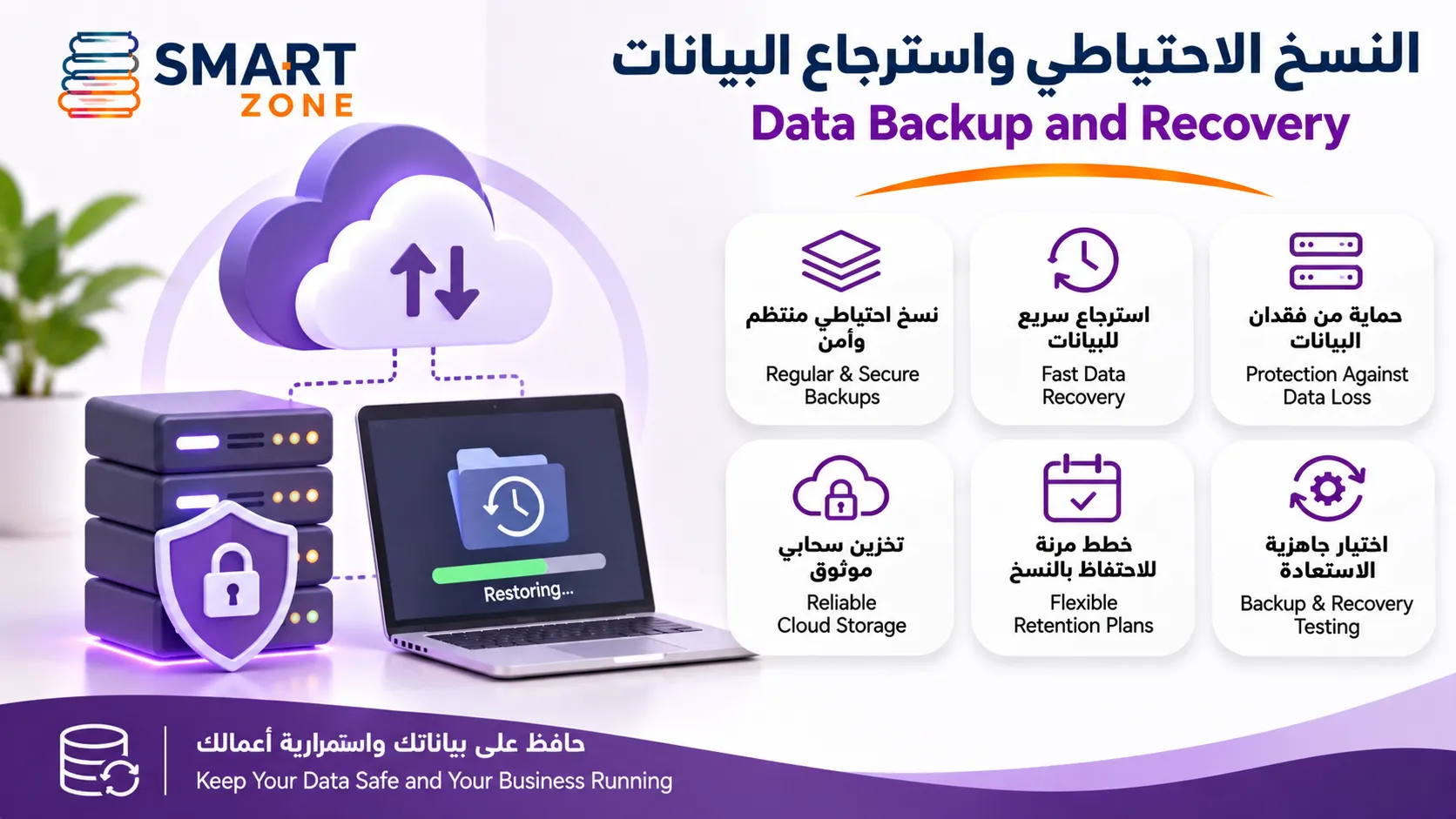
At Smart Zone, we provide data backup and recovery services in Jordan to help businesses protect databases, application files, documents, and other important digital information.
Business data is essential to daily operations. Customer records, orders, transactions, uploaded documents, and operational information may be difficult or costly to recreate if they are lost.
Data loss can result from accidental deletion, application errors, storage failures, unauthorized changes, or other technical incidents.
A reliable backup approach involves more than occasionally copying files. Businesses need to understand which data must be protected, how frequently backups should run, where copies should be stored, how long they should be retained, and whether recovery procedures work.
Our approach focuses on evaluating backup requirements, selecting appropriate storage options, organizing backup workflows, and supporting recovery procedures according to the system's architecture.
We begin by reviewing the types of information stored by the business, their operational importance, and how frequently they change.
This helps define the backup scope, appropriate schedules, and relevant recovery requirements.
We help establish backup procedures for databases used by websites, applications, and business systems.
Activities may include reviewing database export methods, backup integrity, storage arrangements, and recovery compatibility.
Websites may contain application files, images, documents, uploaded media, and other important assets.
We help identify which files require protection and organize backup processes around the website's storage architecture.
Laravel applications may store important information across databases, uploaded files, attachments, and external storage services.
We help identify these data sources and determine appropriate backup procedures.
Cloud storage services can provide an off-site destination for backup copies.
We help evaluate storage options, permissions, encryption, retention policies, and cost considerations.
Backup frequency should reflect how often important data changes and how much potential data loss the business can tolerate.
We help configure suitable schedules and review execution results where supported.
Automation can reduce reliance on manual backup tasks.
However, automated execution does not eliminate the need to monitor failures and verify that backups can be restored.
Businesses may need several historical backup versions to recover information from an earlier point in time.
We help define retention arrangements that consider storage capacity, operational requirements, and data protection obligations.
Keeping all backup copies within the same production environment may expose them to common failures.
We help assess storage separation and appropriate off-site options based on the business's needs.
Backup files may contain sensitive business or personal information.
We consider suitable encryption options, access controls, and secure key management while maintaining authorized recovery capability.
Access to backup files and recovery operations should be restricted to authorized personnel.
We help review roles and permissions appropriate to the selected backup environment.
When data is lost or damaged, recovery may be possible using an available and compatible backup.
The outcome depends on backup integrity, age, database technology, and the condition of the affected system.
Businesses may need to restore individual documents, uploaded media, or groups of application files.
We help review available copies and determine suitable restoration methods while considering the impact on current data.
Not every incident requires a complete system restoration.
Depending on the backup format and application architecture, selected data may be recoverable without replacing the entire dataset.
The existence of a backup file does not guarantee that it can be restored successfully.
We help plan suitable validation and recovery tests using an appropriate environment when available.
Backup operations can fail because of insufficient storage, expired credentials, connectivity issues, or software errors.
We help review logs and configure supported alerts to identify failures.
Backup storage requirements grow as business data and retained versions increase.
We help evaluate storage usage and retention strategies while preserving the recovery capabilities the business requires.
Depending on the storage provider, backup protection may include restricted permissions, retention controls, or immutable storage features.
Availability and configuration depend on the selected platform.
We help document backup schedules, included data, storage locations, access responsibilities, and recovery procedures.
Clear documentation supports more consistent operations and reduces dependence on individual team members.
Backup requirements may change when new features, databases, storage services, or business processes are introduced.
Periodic reviews help determine whether the existing backup strategy still covers important information.
Data backup is the process of creating and retaining additional copies of information so it may be recovered if the original data becomes unavailable, corrupted, or deleted.
Backups may include databases, application files, documents, and selected configuration information.
Data recovery involves using an available backup or other suitable recovery method to restore required information.
Successful recovery depends on backup integrity, compatibility, and the restoration procedure.
Business information may be affected by accidental deletion, software defects, storage problems, or unauthorized changes.
Appropriate backups, combined with recovery testing, improve the possibility of restoring information and reducing potential data loss.
Local backups may offer convenient access within a controlled environment.
Cloud backups can provide storage separation and flexible capacity, depending on the provider.
Each approach has considerations involving cost, security, connectivity, recovery speed, and data location.
The 3-2-1 backup principle recommends keeping three copies of data, using two types of storage media, with at least one copy stored off-site.
Businesses may adapt this approach based on their risk profile and consider additional protections such as immutable backups.
Laravel applications may depend on databases, uploaded documents, media files, and external storage providers.
A complete backup plan should identify all important data sources rather than assuming a database export includes externally stored files.
Data backup and recovery focuses on preserving and restoring information.
Disaster recovery covers a broader set of activities, including restoring applications, infrastructure, connectivity, and business services after a major disruption.
Backup planning should consider authorized access, encryption, retention periods, storage locations, and secure deletion.
Organizations should also review relevant contractual and legal obligations for personal or sensitive data.
We begin by identifying important data and evaluating potential loss scenarios.
Next, we define backup requirements, select suitable storage and scheduling arrangements, and configure the agreed processes.
We then review backup results and support appropriate recovery testing according to the service scope.
We combine website development, application engineering, database knowledge, and cloud-related technical capabilities.
This helps us evaluate backup requirements within the actual architecture of the business system.
Our focus is on organized backup procedures, appropriate access controls, clear responsibilities, and practical recovery planning.
Looking for data backup and recovery services in Jordan, database backup solutions, cloud backup, or Laravel application backup services in Amman?
Contact Smart Zone to discuss your data protection and recovery requirements.
© Smartzone is Proudly Owned by Smartzone Smartzone
