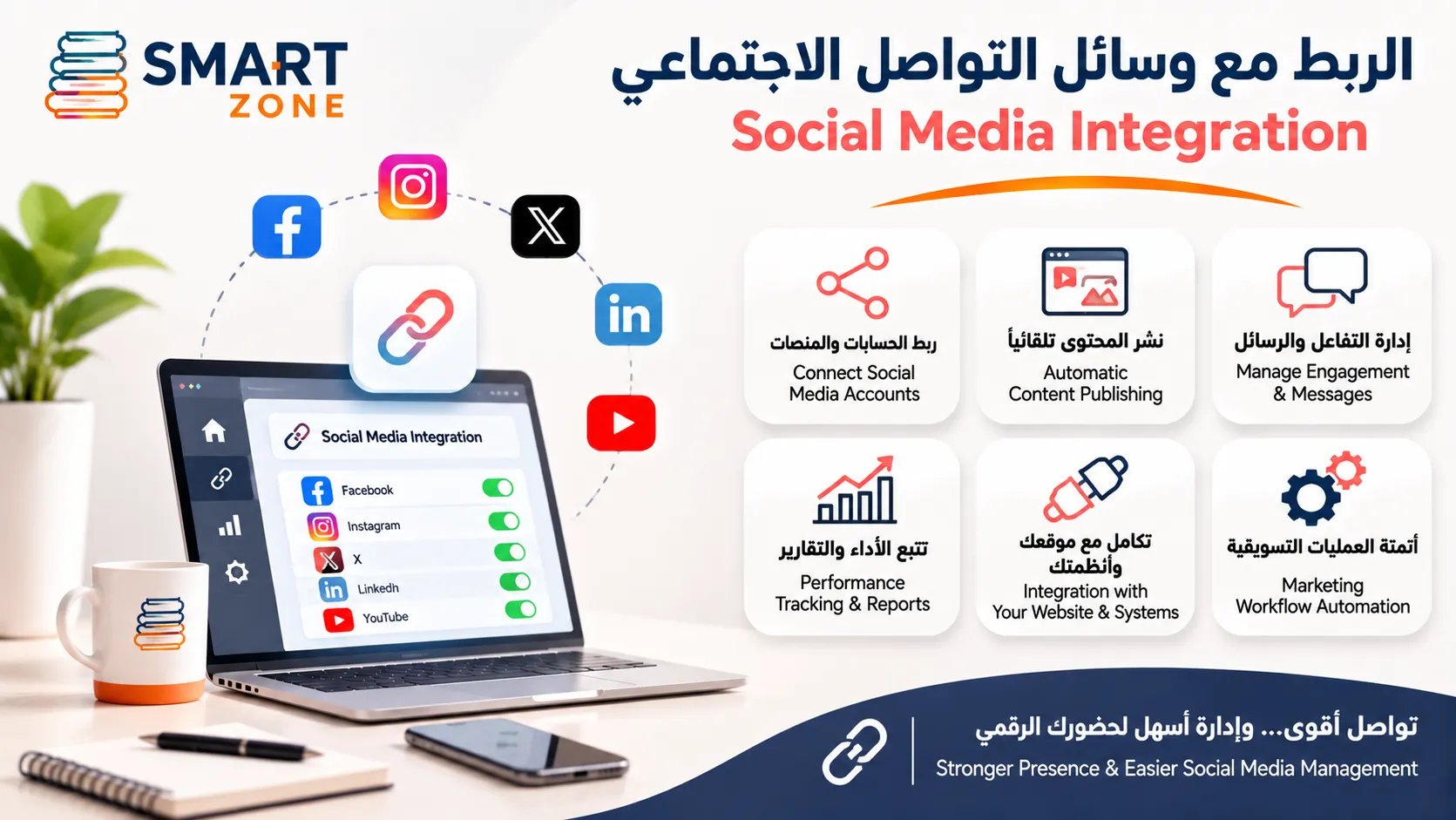
At Smart Zone, we provide social media integration services in Jordan to help businesses connect websites, mobile applications, and business systems with supported social platforms.
Customers interact with businesses across multiple digital touchpoints. A user might discover a service on Instagram, visit the company's website, contact the team through WhatsApp, or sign in to an application using a supported identity provider.
Connecting these experiences can help businesses organize communication, reduce selected manual tasks, and create more consistent digital workflows.
Our approach focuses on identifying suitable integrations, reviewing official APIs, developing secure connections, and testing the resulting functionality against platform requirements.
We help connect business websites with official social media profiles and communication channels.
This can include profile links, social sharing options, and direct contact buttons.
We consider visibility, accessibility, and consistency with the website design.
Some platforms provide APIs that allow approved applications to access specific services and functionality.
We help evaluate available endpoints, permissions, account requirements, and integration restrictions before development.
Businesses can connect their websites with WhatsApp contact options or explore supported WhatsApp Business Platform integrations.
Depending on the provider and approved use case, workflows may include inquiry handling and operational notifications.
Messaging must comply with applicable platform rules and consent requirements.
We can integrate supported identity providers, such as Google or Facebook, where appropriate.
This may allow users to authenticate through an existing account.
Authentication, permissions, and account data handling must follow the provider's requirements.
Supported social lead-generation forms may be connected to CRM systems or internal business applications.
Where approved access is available, relevant lead information can be transferred into organized workflows.
Some social interactions and permitted contact information can be connected with customer management systems.
This can support inquiry organization and internal follow-up processes.
We help embed supported social posts, videos, or other content into websites using official integration methods.
We consider page performance, privacy implications, responsive behavior, and the limitations of external content.
Websites can include options for sharing articles, products, and services across supported platforms.
We can also help configure appropriate sharing metadata, including Open Graph properties, so shared links present relevant titles, descriptions, and images.
Depending on platform availability and eligibility, online stores may be able to connect product catalogs or other commerce-related features with supported social channels.
Capabilities vary by region, account type, and provider policies.
We help prepare landing pages and campaign links for social advertising traffic.
This may include structured tracking parameters and appropriate integration with website analytics.
Supported measurement tools, such as Meta Pixel and relevant event APIs, can be integrated according to project requirements.
We consider event definitions, duplicate prevention, consent requirements, and appropriate data handling.
Some platform events can trigger supported internal business workflows.
Examples may include recording inquiries, notifying team members, or updating a customer record.
Available functionality depends on API permissions and provider capabilities.
Certain platforms provide webhooks to notify connected systems about supported events.
We help develop webhook endpoints, verify incoming requests, and process event data appropriately.
Mobile applications can include supported social sharing, authentication, and communication features.
Implementation may require platform-specific configuration for Android and iOS.
Social integrations may involve access tokens, application permissions, and personal information.
We consider secure credential storage, limited access permissions, and relevant privacy requirements.
We help test connected workflows, review API responses, and address integration errors.
Platform updates, API version changes, and revised provider policies may require future maintenance.
Social media integration is the process of connecting social platforms or supported social functionality with websites, mobile applications, and business systems.
It can range from simple social profile links and sharing buttons to API-based integrations involving CRM systems, messaging services, and analytics.
Appropriate integrations can help organize customer inquiries, reduce duplicated manual work, and support more consistent interactions across digital channels.
The practical benefits depend on the platforms, business processes, and integration capabilities involved.
Social media marketing focuses on content, campaigns, audience engagement, and brand communication.
Social media integration focuses on the technical connections between social platforms and websites, applications, or business systems.
The two disciplines can support each other but serve different purposes.
Meta provides different integration capabilities depending on the product, account, permissions, and approved use case.
Potential applications include selected messaging, measurement, and commerce-related workflows, subject to platform requirements.
Laravel applications can connect with supported APIs and webhook services to process relevant events and organize business workflows.
This can support centralized data handling and integration with existing application logic.
Flutter applications can support certain social login, sharing, and communication features through suitable integrations.
Some functionality requires additional Android or iOS configuration and provider approval.
Social integration should use appropriate authentication, secure token handling, and the minimum permissions required.
Personal data should be processed according to applicable privacy requirements, user permissions, and platform policies.
We begin by identifying the required platforms and business objectives.
Next, we assess API availability, account eligibility, permissions, and technical requirements.
We then develop and test the integration, review error handling and security, and prepare the agreed functionality for release.
We combine website development, mobile application development, backend engineering, and API integration experience.
This allows us to approach social media integration as part of a connected business system.
Our focus is on supported APIs, maintainable integrations, organized data flows, and appropriate security controls.
Looking for social media integration services in Jordan, WhatsApp integration, social login, CRM connectivity, or social API development in Amman?
Contact Smart Zone to discuss your website, application, and social platform integration requirements.
© Smartzone is Proudly Owned by Smartzone Smartzone
