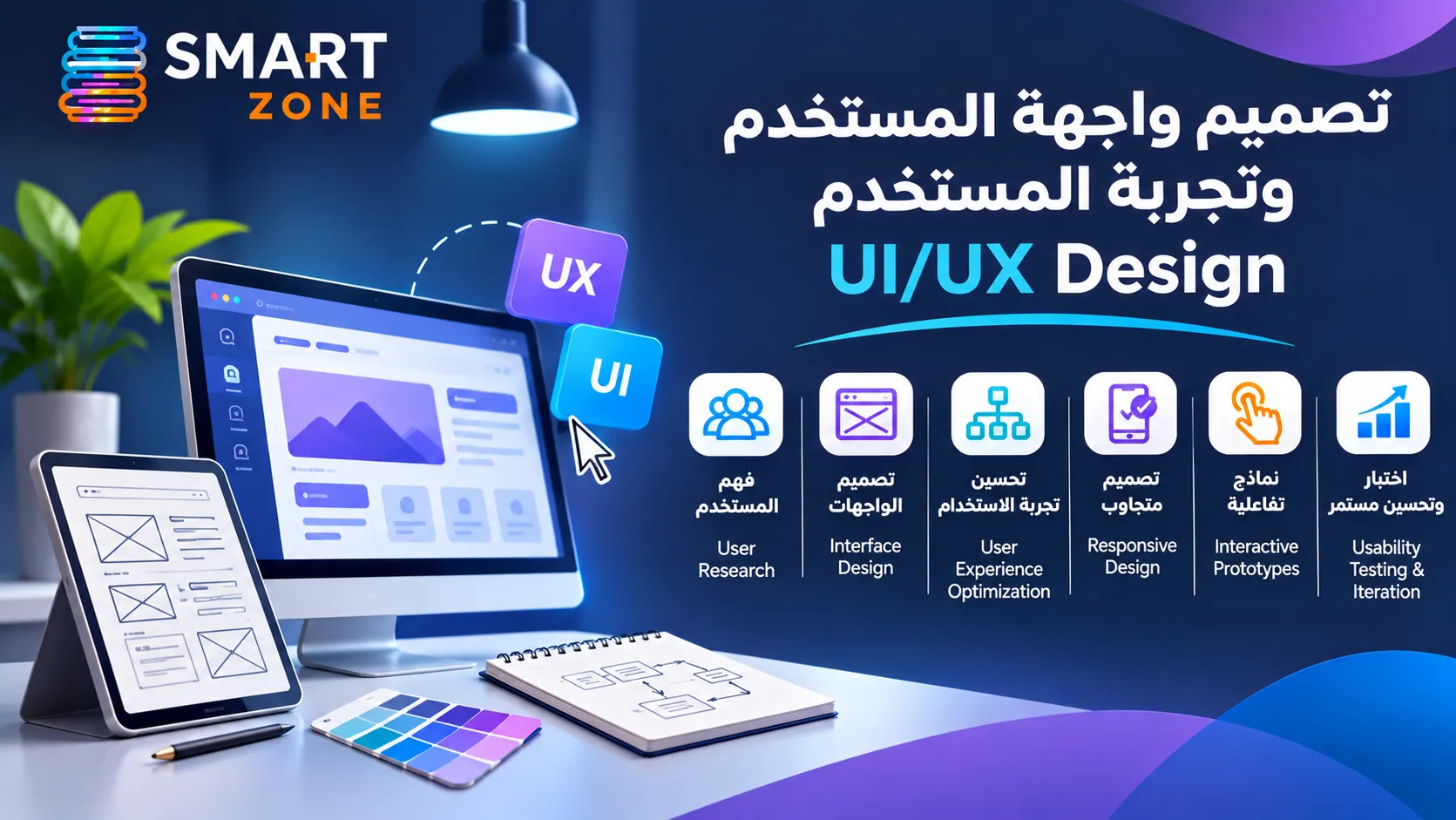
At Smart Zone, we provide UI/UX design services in Jordan to help businesses create professional, intuitive, and user-friendly digital experiences for websites, mobile applications, ecommerce platforms, and business management systems.
An attractive interface is important, but successful digital products also need clear navigation, accessible information, understandable interactions, and efficient user journeys.
Users should be able to find what they need and complete important tasks without unnecessary confusion.
Our approach combines user experience research, interface planning, wireframing, visual design, interactive prototyping, usability considerations, and development collaboration.
Smart Zone helps businesses design Arabic and English digital interfaces with attention to responsive layouts, brand consistency, and practical implementation requirements.
We begin by understanding business objectives, target audiences, product functionality, and design requirements.
This helps establish the design scope and priorities.
We explore user needs, expectations, and behaviors using suitable research methods and available information.
Research findings help inform design decisions.
We review current interfaces to identify usability problems and navigation difficulties.
The assessment may cover forms, menus, page structures, and interaction patterns.
We examine relevant digital experiences to understand common design approaches and opportunities for improvement.
The objective is to develop appropriate solutions rather than copy competitor interfaces.
When sufficient information is available, we help define representative user groups, needs, and objectives.
Personas support more focused design decisions.
We map the stages users follow when interacting with a website or application.
This helps identify potential friction points and improvement opportunities.
We plan the steps required to complete important actions, including registration, searching, booking, and purchasing.
The goal is to create logical and understandable interactions.
We organize content, navigation, and page relationships to make information easier to discover.
This includes menus, categories, and website hierarchy.
We create preliminary layouts that establish page structure and content placement.
Wireframes allow early feedback before detailed visual design begins.
We develop visual interfaces aligned with the project's brand identity and functional requirements.
Design considerations include typography, colors, icons, spacing, and visual hierarchy.
We prepare prototypes that demonstrate screen transitions and important interactions.
Prototypes support stakeholder reviews and early usability evaluation.
We design interfaces that adapt to desktops, tablets, and smartphones.
Layouts are planned for readability and usability across screen sizes.
We create interface designs for Android and iOS applications.
We consider touch interactions, navigation patterns, forms, and mobile user expectations.
We design product pages, categories, shopping carts, and checkout experiences.
The focus is on clear product information and practical shopping journeys.
We create interfaces for dashboards, reporting systems, and administrative platforms.
Information is organized to support efficient access to important functions.
We help design business application interfaces involving tables, workflows, forms, and operational processes.
Usability is especially important for frequently repeated tasks.
We review field organization, labels, validation messages, and error handling.
Clear forms help users complete tasks more easily.
We develop menus, links, and navigation controls that help users understand where they are and how to reach relevant sections.
We design search, sorting, and filtering experiences for platforms with extensive content or product catalogs.
We consider loading, success, error, empty, and other interface states.
Clear feedback helps users understand what is happening.
We design interfaces that support right-to-left (RTL) and left-to-right (LTR) layouts.
This includes typography, alignment, navigation, and component behavior.
We can establish reusable component libraries and visual guidelines covering buttons, inputs, cards, typography, and colors.
Design systems help maintain consistency across digital products.
We consider readability, contrast, labels, and interaction accessibility.
Relevant WCAG requirements can be reviewed according to project scope.
Where appropriate resources and participants are available, we can evaluate selected tasks with representative users.
Testing helps identify issues that may not be obvious during internal design reviews.
We review available user behavior and interaction data to identify potential improvements.
Design decisions are informed by evidence without promising guaranteed conversion increases.
We prepare design files, components, and relevant specifications to support implementation.
Collaboration may involve Laravel, Livewire, Flutter, or other development teams.
We compare implemented interfaces with approved designs and identify important inconsistencies.
Reviews may cover responsiveness, interaction behavior, and visual accuracy.
UI stands for User Interface, referring to the visual and interactive elements people use within a digital product.
UX stands for User Experience, covering how users navigate, understand, and interact with the overall product.
UI focuses on visual presentation, including typography, buttons, colors, and layouts.
UX focuses on the usability, clarity, and overall effectiveness of the user journey.
Both disciplines work together to create coherent digital experiences.
Thoughtful design can reduce unnecessary complexity, improve information accessibility, and make digital products easier to use.
It also supports consistent brand presentation.
We focus on clear page structures, service information, navigation, and contact options.
Responsive behavior is considered throughout the design process.
Mobile experiences require attention to touch interactions, smaller screens, navigation, and efficient task completion.
We design around the application's actual functionality and user needs.
Ecommerce design includes product discovery, product details, shopping carts, and checkout experiences.
The goal is to make shopping information and actions understandable.
We can design custom interfaces for Laravel and Livewire applications, including interactive components, administrative dashboards, and business workflows.
We can prepare screen designs and interactive prototypes for mobile applications intended for Flutter development.
Design decisions are aligned with project requirements and implementation constraints.
No. Visual quality is only one part of a successful digital product.
Usability, content quality, performance, accessibility, and functionality also matter.
We begin by understanding business requirements and user needs.
Next, we organize information, map user flows, and prepare wireframes.
We then develop visual designs and prototypes, gather feedback, and prepare approved assets for implementation.
Smart Zone combines interface design, website development, mobile application development, and performance optimization.
This helps us create designs that consider both user experience and technical implementation.
Our focus is on practical usability, consistent visual systems, and digital products that support real business needs.
Looking for UI/UX design services in Jordan, professional website interface design in Amman, mobile app UX design, or ecommerce interface improvements?
Contact Smart Zone to discuss your digital product, design requirements, and business objectives.
© Smartzone is Proudly Owned by Smartzone Smartzone
