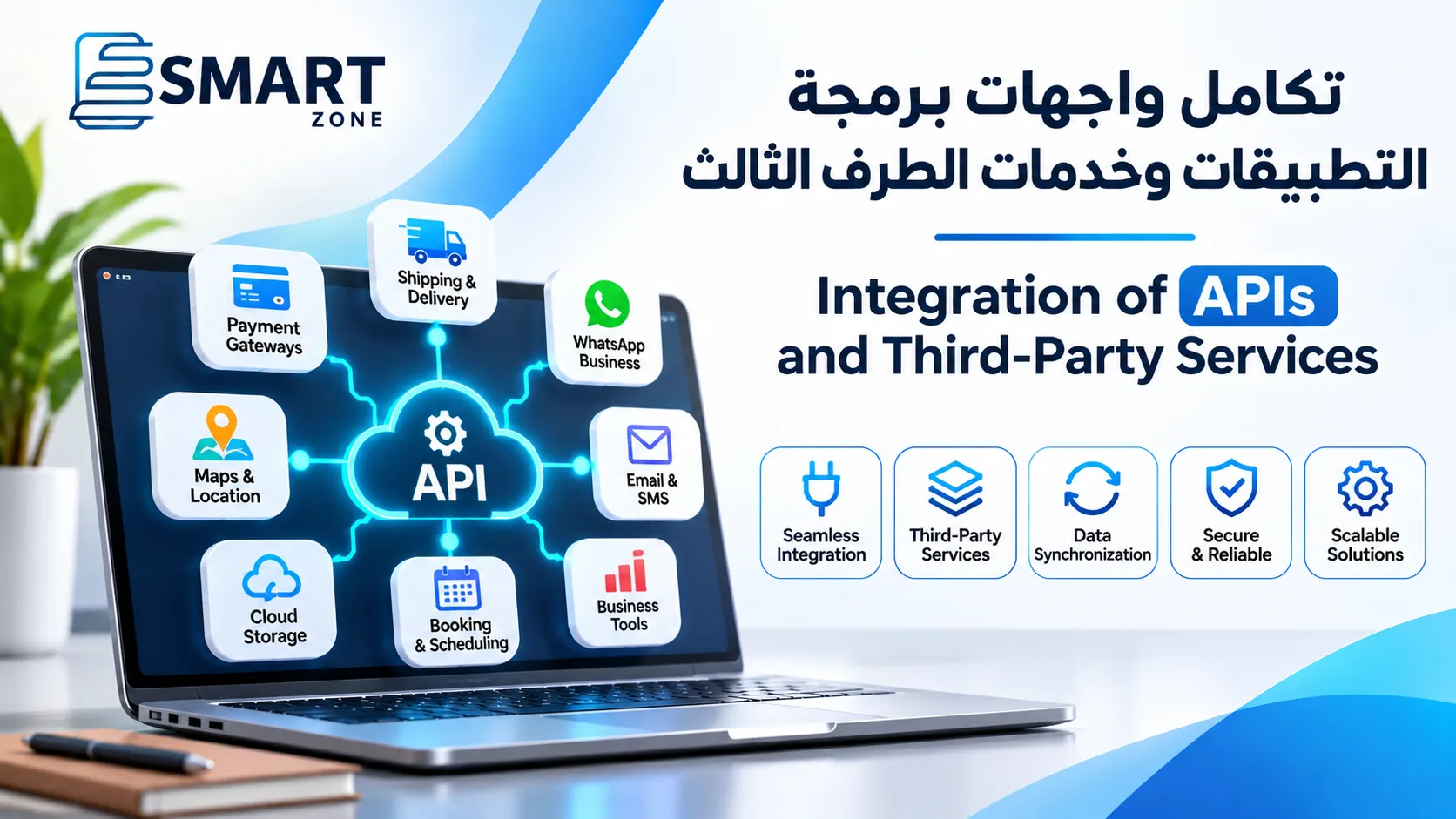
Smart Zone provides API integration and third-party service integration in Jordan, helping businesses connect websites, mobile applications, enterprise systems, and external platforms.
Modern organizations often rely on multiple tools, including ecommerce platforms, CRM systems, ERP software, payment gateways, logistics providers, messaging services, and cloud storage.
When these systems operate separately, teams may need to duplicate data entry or transfer information manually between platforms.
API integration helps organize data exchange and automated operations between connected systems, depending on the capabilities, permissions, and policies of each service.
At Smart Zone, we analyze integration requirements and develop connections using technologies such as PHP, Laravel, REST APIs, and webhooks, considering authentication, access control, error handling, and operational monitoring.
We review existing applications and external services to identify the information and operations that need to move between systems.
We connect applications with services offering REST APIs to retrieve, create, and update authorized information.
We use Laravel to organize communication with external platforms, process responses, and handle integration workflows.
We develop PHP-based integrations when appropriate for the existing system architecture.
We connect websites and applications with supported payment providers, including transaction status handling and verification of payment notifications.
We connect ERP platforms with ecommerce applications and other business systems through available integration interfaces.
We connect customer records, inquiries, orders, and sales opportunities with supported CRM systems.
We develop connections for exchanging product, order, inventory, and customer information between platforms.
We connect systems with supported logistics providers to exchange shipment details, order statuses, and available tracking information.
We develop integrations with supported or approved WhatsApp interfaces according to provider capabilities and policies.
We connect applications with email providers for transactional messages, operational alerts, and relevant notifications.
We implement integrations with messaging providers for verification codes, notifications, and status updates.
We connect applications with supported mapping and location services for addresses, location search, and field operations.
We integrate supported storage services for file uploads, retrieval, and access management.
We support suitable exchange of invoices, payment records, and customer information with accounting systems offering integration capabilities.
We develop connections between employee systems, attendance services, and supported administrative platforms.
We connect applications with supported booking and appointment services to exchange information and update statuses.
We implement supported external login and identity services where suitable.
We use appropriate authorization flows for services that support OAuth 2.0.
We develop webhook senders and receivers for event-driven communication, including request verification where supported.
We build processes for synchronizing information between platforms while considering update rules and conflicting changes.
We connect application events to automated actions such as creating records, updating statuses, and sending alerts.
We connect Android and iOS applications with supported payment, messaging, mapping, and other services.
We develop features that allow administrators to review integration statuses, records, and operational settings.
We support data and content exchange with platforms providing suitable integration interfaces.
We connect applications with supported marketing platforms for relevant event and lead data, subject to permissions and applicable requirements.
We implement suitable event and data exchange with supported analytics tools while considering consent and privacy settings.
We develop mechanisms for handling failed requests, timeouts, and unexpected responses.
We implement appropriate retry policies for temporary failures while avoiding unintended duplication of sensitive operations.
We consider provider request limits and organize communication to respect usage restrictions.
We help organize the storage and access of integration credentials and API keys.
We consider encrypted connections, authorization, and limiting exchanged information to what is necessary.
We use background queues where appropriate for operations that do not require immediate responses.
We develop relevant logs and status indicators to support troubleshooting and operational reviews.
We test requests, responses, failure scenarios, and data exchange before deployment.
We document connected services, authentication requirements, workflows, and important configuration details.
We review and modify existing integrations when providers change their APIs or system requirements evolve.
Monitoring, maintenance, troubleshooting, and updates can be provided under an agreed support arrangement.
API integration connects a software application with another system through an interface made available by a service provider.
It enables authorized data exchange and operations without requiring users to enter the same information manually in multiple platforms.
A company may use an ecommerce website, ERP system, CRM platform, shipping provider, and payment gateway simultaneously.
Connecting these services can reduce duplicate data entry, support more consistent information, and simplify operational workflows, depending on the integration design.
API development creates new interfaces that expose application functionality.
API integration uses existing interfaces to connect applications with external systems or services.
Some projects require both approaches.
Laravel provides tools for making HTTP requests, processing background jobs, handling errors, and recording application events.
We use these capabilities where suitable to develop structured third-party integrations.
Applications can connect with supported payment, logistics, and messaging providers when the required APIs, permissions, and subscriptions are available.
Specific functionality depends on the provider and its policies.
Integrations require appropriate API credential protection, identity verification, access management, and sensitive data handling.
Privacy requirements and provider policies must also be considered.
Integrations may be affected by provider API changes, request limits, connection interruptions, and differences in data formats.
Appropriate error handling, retries, monitoring, and documentation can help manage these challenges.
Analyze the systems and services to be connected.
Review provider documentation and available capabilities.
Define data exchange, workflows, and synchronization rules.
Configure authentication and permissions.
Develop communication and processing logic.
Implement error handling and monitoring.
Test expected operations and failure scenarios.
Prepare the integration for deployment.
Provide maintenance and enhancements as agreed.
Smart Zone combines PHP and Laravel development, mobile applications, enterprise systems, and API engineering.
This helps us implement integrations aligned with operational needs while considering security, maintainability, and third-party service limitations.
Looking for API integration services in Jordan to connect your website, mobile app, ERP, or CRM system with payment gateways, logistics providers, messaging services, or cloud storage?
Contact Smart Zone to discuss your requirements and available integration options.
© Smartzone is Proudly Owned by Smartzone Smartzone
