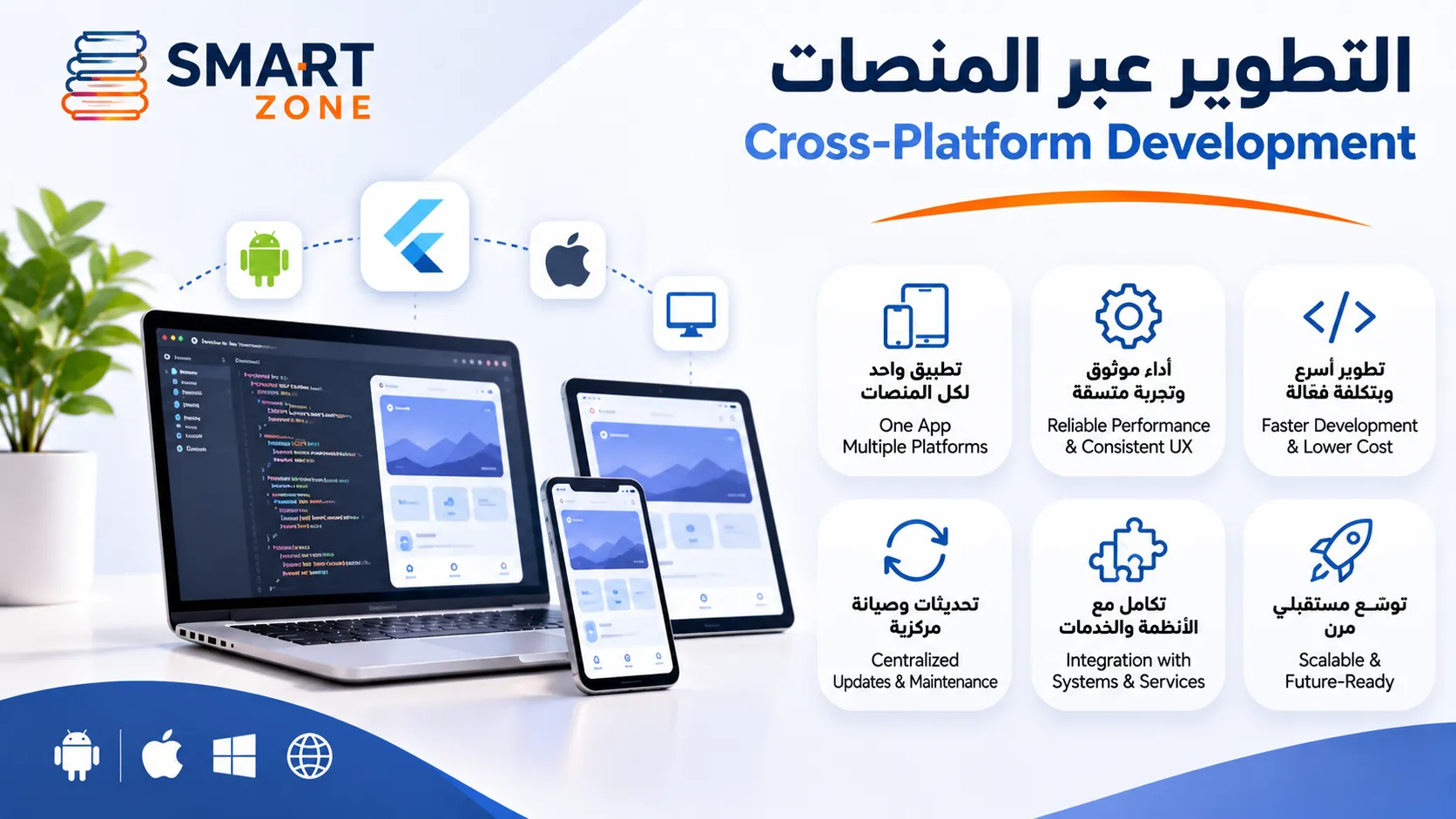
At Smart Zone, we provide cross-platform development services in Jordan to help businesses build applications for multiple operating systems while maintaining consistent functionality, a cohesive user experience, and a manageable development process.
Many organizations need to reach both Android and iOS users without maintaining two entirely separate application projects.
Cross-platform technologies make it possible to share significant portions of application code while still addressing platform-specific requirements.
Our approach combines requirements analysis, interface design, mobile development, backend integration, testing, and deployment planning to deliver applications aligned with business needs.
We begin by understanding the application's purpose, target audience, and required features.
We review user journeys, account types, permissions, data requirements, external integrations, and deployment considerations.
This helps establish a clear project scope before development begins.
We help build applications targeting Android and iOS using suitable cross-platform development technologies.
Shared application components can support a consistent experience while allowing necessary platform-specific adjustments.
Flutter is a development framework that supports applications across multiple platforms.
We can use it to develop interfaces, application logic, reusable components, and integrations with backend services, according to project requirements.
We design interfaces that support clear navigation and practical mobile interactions.
This can include onboarding screens, forms, menus, cards, account pages, notifications, and different interface states.
Mobile applications often require backend services for account management, data processing, and business operations.
We help develop or integrate suitable APIs, including Laravel-based backend systems where appropriate.
Applications may include registration, authentication, profile management, and role-based access.
Access mechanisms are designed according to application requirements and relevant data protection considerations.
We connect mobile applications with backend services responsible for storing, retrieving, and updating information.
We consider input validation, error handling, data consistency, and synchronization requirements.
Applications may need integrations with payment gateways, mapping services, messaging platforms, CRM systems, or cloud storage providers.
We assess available APIs, provider restrictions, and technical requirements before implementation.
Applications can include notifications triggered by relevant events, such as order updates, messages, or changes in service status.
Notification availability and behavior depend on operating system requirements, device settings, and user permissions.
We help build mobile applications connected to ERP, CRM, order management, and other business systems.
These applications can provide access to selected business functions while respecting user roles and permissions.
Cross-platform development can support mobile shopping experiences with product catalogs, customer accounts, carts, orders, and relevant integrations.
The final feature set depends on the business model and existing e-commerce infrastructure.
We can prepare applications supporting Arabic and English interfaces.
This includes considering right-to-left and left-to-right layouts, translated content, and appropriate navigation patterns.
We review factors that influence responsiveness, including data loading, image handling, scrolling behavior, and application processes.
Optimization priorities are based on the application's requirements and testing results.
Applications require testing across relevant devices, operating system versions, and screen sizes.
Testing can include authentication, permissions, integrations, notifications, error handling, and network connectivity scenarios.
We help prepare application builds and relevant release requirements for supported distribution channels.
Publication remains subject to the review processes and policies of Google Play and the Apple App Store.
After release, applications may require bug fixes, dependency updates, compatibility adjustments, and additional functionality.
Ongoing maintenance can be arranged according to the agreed project scope.
Cross-platform development is an approach to building applications for more than one operating system using shared tools and code.
It differs from maintaining entirely independent native applications, although some platform-specific implementation may still be required.
Native development uses the programming languages and tools associated with a particular operating system.
Cross-platform development shares application components between operating systems.
The appropriate choice depends on performance requirements, device integrations, application complexity, budget, and long-term maintenance considerations.
Cross-platform development may reduce duplicated work, improve consistency between applications, and simplify some updates.
However, the actual benefits depend on the application's architecture and the amount of platform-specific functionality required.
Flutter can be suitable for service applications, booking platforms, order management, business tools, and other mobile products.
Its suitability should be evaluated against each project's technical and operational requirements.
A Flutter application can communicate with a Laravel backend through APIs.
This approach can support centralized management of users, data, and business operations while providing mobile interfaces for Android and iOS.
Application development should consider secure communication, appropriate authorization, safe session handling, and protection of user information.
Detailed security controls depend on the application's data, functionality, and risk profile.
We begin with requirements analysis and project planning, followed by interface design, application development, and backend integration.
The application then moves through appropriate testing and release preparation.
Documentation and maintenance requirements are addressed according to the agreed scope.
We combine mobile application development with backend engineering, API integration, and database expertise.
This allows us to approach mobile applications as part of a connected business system rather than isolated screens.
Our focus is on usability, maintainable architecture, practical integrations, and future development needs.
Looking for cross-platform app development services in Jordan, Flutter developers in Amman, or an Android and iOS application connected to your business software?
Contact Smart Zone to discuss your application idea, technical requirements, and development goals.
© Smartzone is Proudly Owned by Smartzone Smartzone
