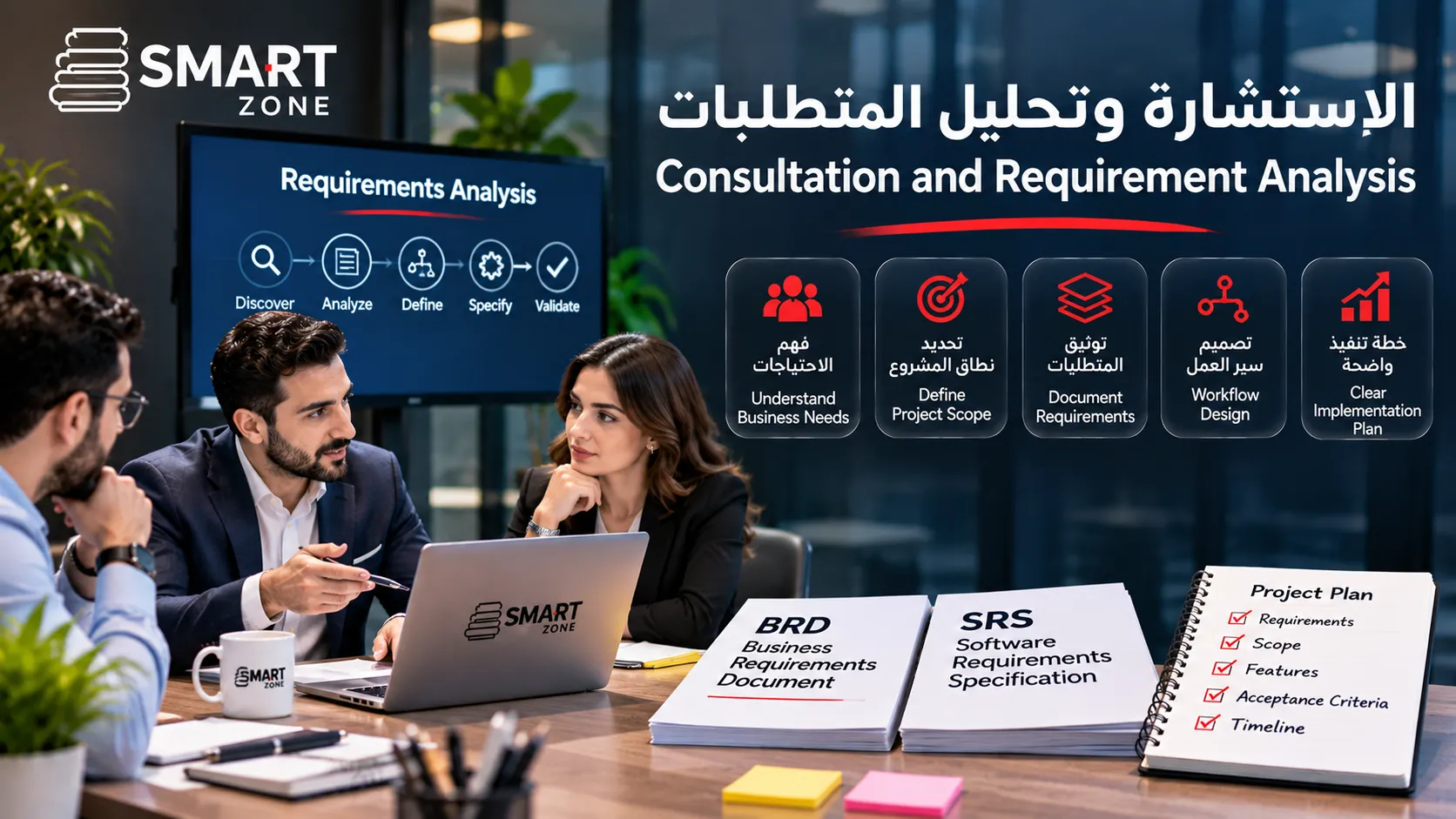
At Smart Zone, we provide software consultation and requirements analysis services in Jordan to help businesses transform project ideas and operational needs into clear, structured specifications for websites, mobile applications, enterprise systems, and custom software solutions.
Requirements analysis is an essential part of the software development lifecycle. It defines what a system must do, how users interact with it, which business rules apply, and what technical and operational conditions the solution must satisfy.
A structured analysis process helps reduce misunderstandings, identify conflicting expectations, clarify project scope, and create a stronger foundation for design, development, and testing.
Our approach emphasizes stakeholder communication, detailed documentation, requirement prioritization, and review before implementation begins.
We begin by consulting with business owners, managers, and relevant system users to understand the required functionality.
Structured discussions, workflow reviews, and operational scenarios help identify initial requirements and areas requiring clarification.
Functional requirements describe the operations a system must perform.
These may include user registration, order processing, reporting, notifications, approval workflows, and administrative controls.
We help document expected behavior, inputs, outputs, and relevant business rules.
Non-functional requirements describe how the system should perform and operate.
They may address performance, security, scalability, usability, compatibility, availability, and maintainability.
Where appropriate, we help define measurable criteria based on the project's operational needs.
Applications with multiple user types require clear access control rules.
We help identify user categories, responsibilities, permitted actions, data access requirements, and approval processes.
These specifications can guide both application development and security testing.
We review the sequence of activities users perform within the proposed system.
Workflow diagrams and process descriptions can help clarify how information moves between users, departments, and application functions.
This supports the identification of missing steps and potential operational conflicts.
We help document user interactions through use cases and user stories.
These descriptions may include preconditions, main workflows, expected outcomes, alternative scenarios, and relevant exceptions.
They provide practical references for developers, designers, and testers.
We help identify the data the system must collect, store, process, and display.
This may involve data relationships, validation rules, status transitions, calculation logic, and information retention considerations.
The analysis supports subsequent database and application architecture decisions.
Many digital systems need to communicate with payment gateways, accounting software, messaging services, or external platforms.
We help define integration objectives, required data exchanges, dependencies, access requirements, and error-handling scenarios.
Depending on the agreed scope, we can prepare a Software Requirements Specification (SRS) that organizes the system's functional and non-functional requirements.
An SRS may include project scope, user roles, feature descriptions, integrations, constraints, assumptions, and acceptance criteria.
It may also reference a Business Requirements Document (BRD) when relevant.
Not all requirements have the same urgency or business value.
We help classify features according to importance, dependencies, and implementation priorities.
Clear acceptance criteria also support objective verification during development and testing.
Before implementation, documented requirements should be reviewed with relevant stakeholders.
This helps identify ambiguities, missing information, inconsistencies, and conflicting expectations.
Approved requirements provide a more reliable reference for subsequent project activities.
New requirements may emerge during project implementation.
We help document proposed changes and assess their potential impact on scope, dependencies, schedule, and cost before decisions are made.
Requirements analysis helps establish a shared understanding between business stakeholders and technical teams.
It supports better planning, clearer software design, more informed effort estimation, and test cases aligned with agreed functionality.
Although no analysis process eliminates every project risk, structured requirements can make changes easier to evaluate and manage.
For website and mobile application projects, requirements analysis can define page structures, user journeys, administrative features, forms, notifications, integrations, and interactive functionality.
These specifications help guide UI/UX design, development, and quality assurance.
ERP projects often involve multiple departments, interconnected workflows, shared data, and complex user permissions.
Requirements analysis helps define the modules, business rules, reports, and integrations needed to support the organization's operations.
Needs analysis focuses on identifying business problems, objectives, and desired outcomes.
Requirements analysis translates those needs into specific system functions, constraints, rules, and verifiable specifications.
Both activities contribute to a well-defined software project.
We combine business-oriented analysis with practical experience in website development, mobile applications, and custom software systems.
Our approach emphasizes clear documentation, stakeholder alignment, realistic prioritization, and requirements that development teams can understand and implement.
Looking for software requirements analysis services in Jordan, SRS documentation, or technical consultation for a custom application or ERP project in Amman?
Contact Smart Zone to discuss your project requirements and establish a clear foundation for development.
© Smartzone is Proudly Owned by Smartzone Smartzone
