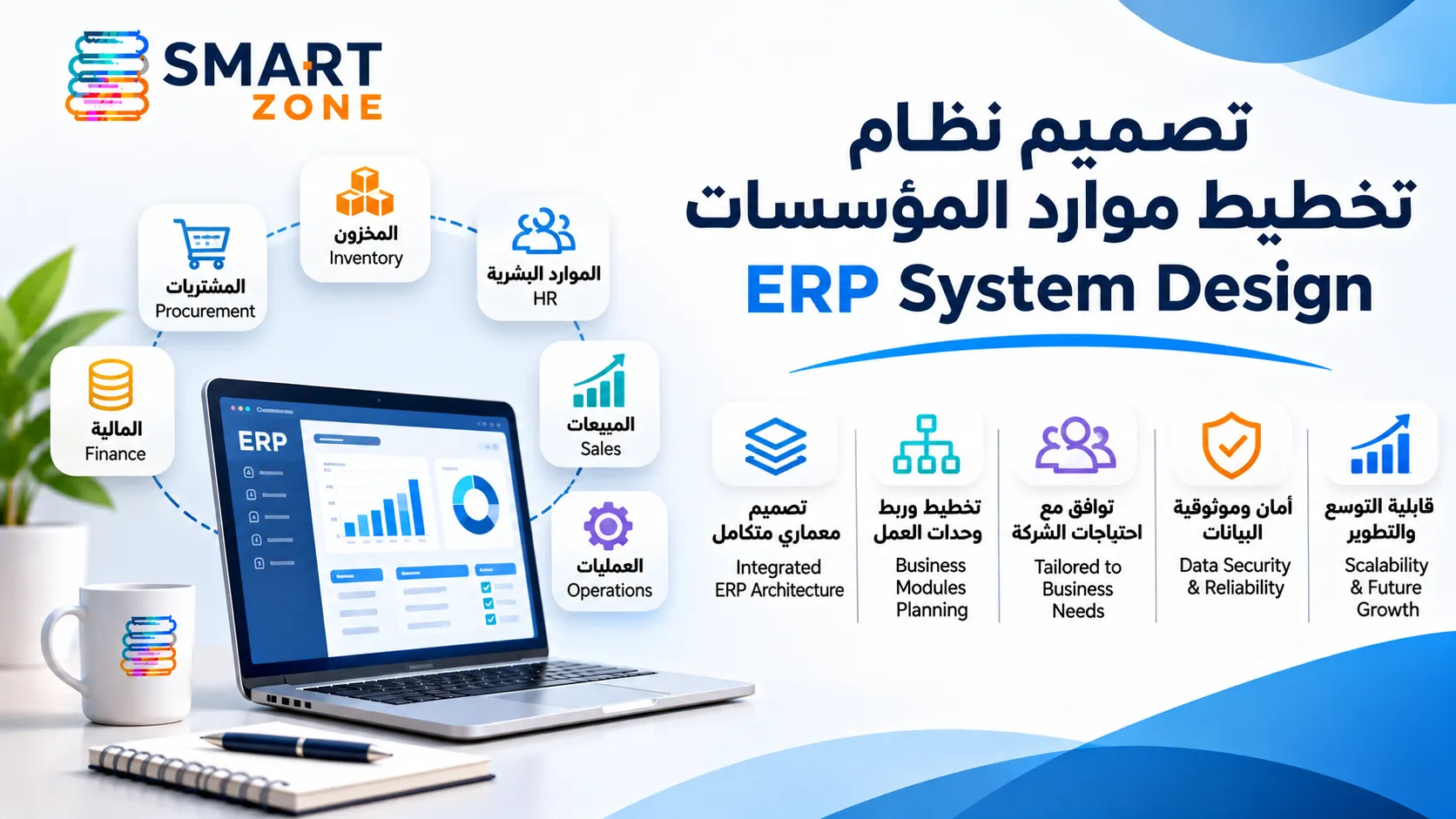
At Smart Zone, we provide ERP system design services in Jordan to help businesses plan integrated software solutions that connect departments, organize operational workflows, and support consistent information management.
As businesses grow, managing operations through disconnected applications, spreadsheets, and manual procedures can become increasingly complicated.
Duplicate data entry, fragmented reporting, and inconsistent workflows may create unnecessary administrative effort and make it harder to understand business performance.
A well-planned Enterprise Resource Planning system establishes how business processes, data, users, and functional modules work together.
Smart Zone helps organizations analyze requirements and design ERP structures, databases, user interfaces, permissions, workflows, reporting, and integrations according to their operational needs.
We begin by understanding the organization's structure, existing systems, and operational objectives.
We identify important challenges and opportunities for improvement.
We review how work moves between departments and how information is exchanged.
This helps identify unnecessary duplication and complex procedures.
We document functional and non-functional requirements with relevant stakeholders.
Requirements may cover features, permissions, reporting, security, performance, and integrations.
We help determine which modules and functions belong in the initial project scope.
Additional capabilities can be prioritized for later stages.
We develop an overview of the main modules, their responsibilities, and how they share information.
Architecture planning considers maintainability and future changes.
We help plan functions for accounts, invoices, payments, expenses, and financial reporting according to business requirements.
Specialized accounting rules should be reviewed by qualified professionals.
We plan workflows covering quotations, sales orders, invoicing, and follow-up.
Connections to customers, inventory, and finance are considered.
We help organize purchase requests, suppliers, purchase orders, and receiving procedures.
Approval stages and relevant module relationships are identified.
We plan product records, stock levels, warehouses, and inventory transactions.
Tracking and data consistency requirements are considered.
We help define receiving, issuing, transfers, stock counts, and storage locations where applicable.
We plan customer records, sales opportunities, communication histories, and follow-up processes.
CRM relationships with sales and service modules are considered.
We help define employee records, leave requests, attendance, permissions, and administrative workflows.
Requirements depend on company policies and applicable regulations.
Where needed, we help plan payroll data structures, calculation workflows, deductions, and approval processes.
Legal and accounting requirements should be validated by relevant specialists.
We plan features for projects, tasks, responsibilities, deadlines, and progress monitoring.
We help organize asset records, locations, conditions, maintenance histories, and related procedures.
For manufacturing organizations, we can plan production orders, materials, operational stages, and production tracking.
The scope depends on the production environment.
We help define information flows between purchasing, suppliers, inventory, and distribution operations.
We plan workflows for receiving, assigning, processing, and tracking requests.
Processes are adapted to the organization's services.
We define task sequences, approvals, responsibilities, and relevant exceptions.
Escalation paths can be considered where necessary.
We plan access levels based on organizational responsibilities.
Sensitive functions can incorporate separation of duties and least-privilege principles.
We define relevant data entities, relationships, and constraints.
The objective is to support consistent information across modules.
We plan how sales, inventory, purchasing, finance, and other modules exchange information.
This can reduce unnecessary duplicate data entry.
We create interface designs for forms, tables, menus, and operational screens.
The focus is on clarity and efficient task completion.
We plan dashboards that present information relevant to different user roles.
Executives, managers, and employees may require different views.
We identify reporting requirements, data sources, filters, and access permissions.
We plan alerts for approvals, tasks, order changes, inventory events, and other important activities.
We evaluate requirements for connecting ERP with payment systems, accounting platforms, ecommerce stores, messaging services, and other applications.
Integration feasibility depends on available interfaces and permissions.
We plan APIs that allow authorized applications and services to exchange data with the ERP platform.
Authentication and access control are considered.
We help plan structures supporting multiple branches, warehouses, and user groups.
Shared and branch-specific information is defined according to business requirements.
We can plan systems that support multiple companies or legal entities with appropriate data boundaries and permissions.
We consider Arabic and English interfaces, including RTL and LTR layouts.
We plan suitable experiences for desktops, tablets, and mobile devices where operational requirements justify them.
We consider data protection, authentication, authorization, and sensitive operation controls.
Controls should reflect the organization's risk profile.
We help identify important actions and data changes that should be logged for accountability and review.
We identify existing data sources and requirements for cleaning, mapping, transferring, and validating information.
We consider expected user volumes, data growth, and operational workloads when planning the system.
We create wireframes and interactive prototypes to demonstrate workflows and interface concepts.
Prototypes help stakeholders review requirements before development.
We review important scenarios with relevant departments to confirm that proposed workflows meet their needs.
We can prepare requirements documents, workflow diagrams, database models, module descriptions, and permission specifications.
We prepare approved design materials to support implementation.
Coordination may involve Laravel, Livewire, and mobile application development teams.
Enterprise Resource Planning (ERP) software helps organizations manage multiple business functions through connected modules and shared information.
Modules may include finance, sales, purchasing, inventory, HR, and project management.
Planning helps clarify business processes, data relationships, permissions, and module dependencies before implementation.
This can reduce the risk of significant misunderstandings later in the project.
ERP design focuses on business analysis, module planning, data structures, workflows, and interface specifications.
ERP development covers programming, testing, deployment, and actual integration.
Different organizations have different operational requirements.
Custom ERP planning should reflect actual business processes rather than assume every company needs the same modules.
Typical requirements may involve sales, purchasing, inventory, suppliers, customers, invoices, and reporting.
Relevant modules may include customer management, contracts, projects, tasks, billing, and HR.
Planning may involve production, raw materials, inventory, purchasing, quality processes, and operational tracking.
We can plan functional and technical structures for ERP systems intended for Laravel and Livewire development.
This includes modules, permissions, database relationships, and workflows.
Cloud-based ERP planning considers access requirements, availability, security, hosting costs, and operational responsibilities.
Integration can be planned when the external systems provide suitable APIs, access permissions, and technical capabilities.
We begin by analyzing business processes and organizational objectives.
Next, we gather requirements and define modules, priorities, and workflows.
We then plan data structures, permissions, interfaces, reports, and integrations.
Designs are reviewed with stakeholders before being prepared for implementation.
Smart Zone combines business requirements analysis, database design, user interface design, and software development capabilities.
This helps us approach ERP planning with attention to operational needs, usability, and technical implementation.
Our focus is on organized business workflows, practical system structures, and maintainable digital solutions.
Looking for ERP system design services in Jordan, custom ERP planning in Amman, inventory management system design, or integrated business software architecture?
Contact Smart Zone to discuss your organization's workflows, requirements, and ERP project objectives.
© Smartzone is Proudly Owned by Smartzone Smartzone
