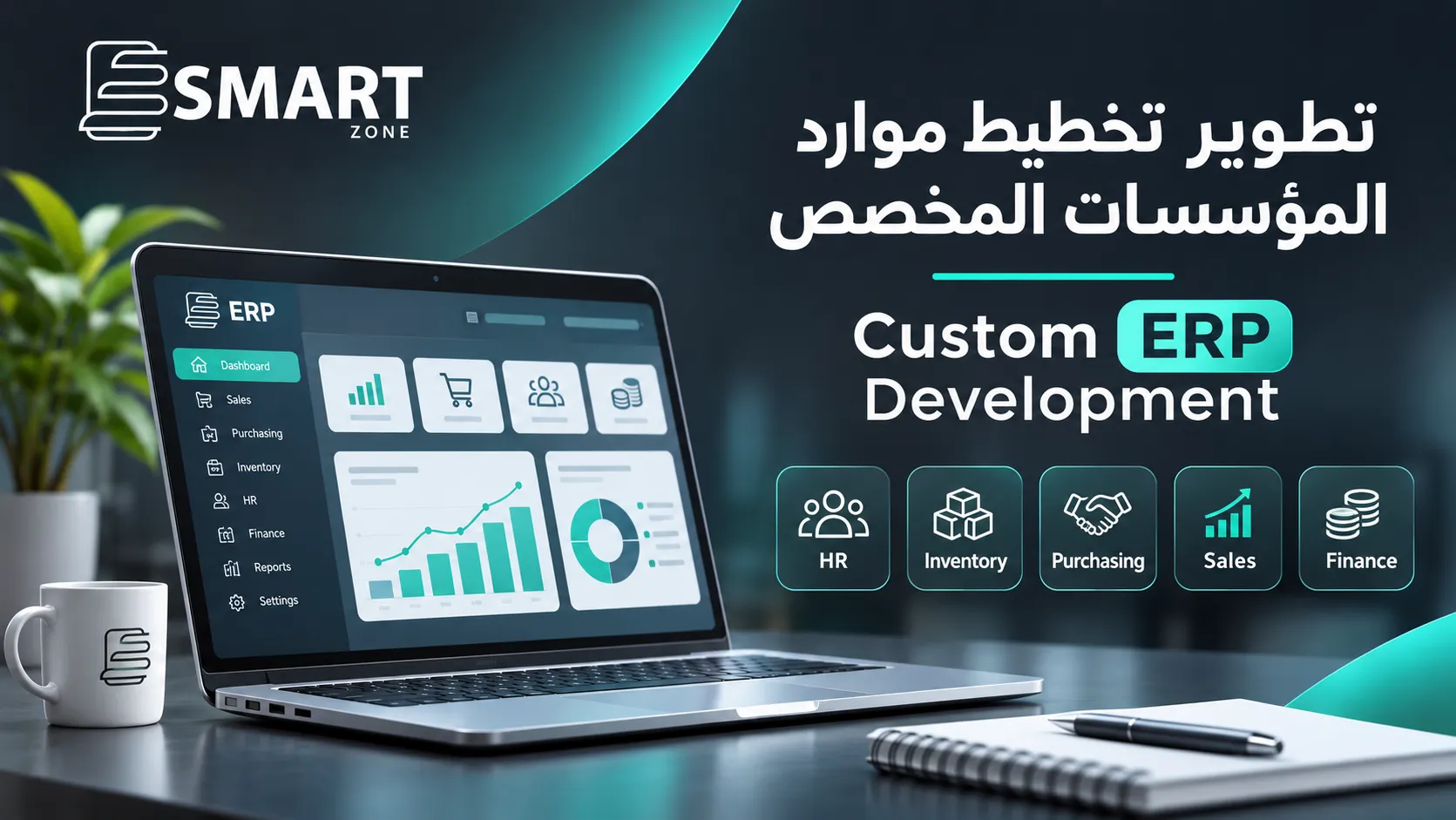
Smart Zone provides custom ERP development services in Jordan, helping businesses and organizations build integrated enterprise resource planning systems tailored to their operational requirements, internal workflows, and organizational structures.
Businesses often need software that connects departments, organizes information, and supports financial, administrative, and operational activities. Standard ERP platforms may not always accommodate specialized processes, unique approval structures, or specific integration requirements.
At Smart Zone, we analyze business requirements and develop tailored ERP solutions using technologies such as PHP, Laravel, Livewire, databases, and APIs, considering each project's scope, security requirements, and future growth.
We review business processes, departments, operational challenges, and functional requirements before defining the system scope.
We develop ERP software designed around the organization's actual workflows and business rules.
We build features for managing financial records, invoices, expenses, and reports according to defined accounting requirements.
We develop functionality for quotations, sales orders, customers, invoices, and sales workflows.
We create features for purchase requests, suppliers, quotations, approvals, and purchase orders.
We build tools for monitoring products, stock quantities, inventory movements, and related notifications.
We develop features for warehouse locations, receiving, issuing, and stock transfers.
We implement functionality for employee records, departments, leave requests, and administrative approvals.
Where required, we develop payroll-related data and calculation features based on the organization's approved policies and applicable requirements.
We connect customer information, inquiries, opportunities, and orders with relevant ERP processes.
We develop tools for tracking projects, tasks, milestones, responsibilities, and progress.
We build functionality for organizing asset records, equipment, locations, and operational status.
We develop features for managing contract records, documents, dates, statuses, and reminders.
We implement approval, review, and escalation processes based on defined organizational rules.
We automate suitable repetitive tasks, including status updates, notifications, and selected process transitions.
We define access permissions for users and departments according to their responsibilities.
We build centralized dashboards for managing operations, users, data, and system configuration.
We develop reports for reviewing sales, procurement, inventory, resources, and business activities.
We create dashboards displaying relevant business indicators and operational information.
We design database structures and relationships that support connected business modules and consistent data management.
We use Laravel to implement business logic, backend services, authentication, authorization, and data processing.
Where appropriate, we use Livewire to develop interactive tables, forms, filters, and administrative interfaces.
We connect relevant product, order, inventory, and customer data between ecommerce platforms and ERP systems where supported.
We implement appropriate integrations with supported payment services for transaction and payment status management.
We connect ERP software with supported logistics, messaging, accounting, and other external systems through available APIs.
We build APIs that allow the ERP system to exchange information with connected applications and services.
We develop functionality for storing and associating documents with orders, contracts, invoices, and other records.
We implement notifications for approvals, orders, inventory conditions, deadlines, and important events.
We develop functionality for managing operations and information across multiple branches or locations.
Where required, we design systems supporting multiple business entities with appropriate data and access separation.
We develop multilingual interfaces supporting RTL and LTR layouts.
We consider the possibility of introducing additional modules and extending functionality as business requirements evolve.
We support migration from existing systems after reviewing data sources, structure, quality, and migration requirements.
We review module functionality, workflows, permissions, reports, and integrations before deployment.
We support system deployment preparation and can provide user orientation or training according to the agreed scope.
Maintenance, troubleshooting, updates, and additional development can be provided under an agreed support arrangement.
Custom ERP development involves building an integrated software system designed to manage an organization's resources and operations according to its specific requirements.
The system may include sales, procurement, inventory, human resources, financial management, and other modules depending on business needs.
Off-the-shelf ERP systems provide standardized features and may be suitable for organizations with common operational requirements.
Custom ERP systems offer greater flexibility in defining workflows, modules, permissions, and integrations, but require appropriate analysis, development, testing, and maintenance.
Organizations may need custom ERP solutions when their operations rely on disconnected software, specialized workflows, or complex departmental processes.
A tailored ERP system can provide a more centralized environment for managing information and business activities.
Smart Zone uses PHP and Laravel to develop tailored business systems with structured workflows, database operations, permissions, and integrations.
The final technical architecture depends on system size, operational requirements, and security considerations.
ERP projects can be delivered in phases, beginning with priority modules such as sales, inventory, and procurement.
Additional modules can be introduced as requirements evolve.
We can develop ERP functionality connecting different departments through shared workflows, defined permissions, and relevant reports.
Analyze the organization and existing processes.
Gather requirements and define ERP modules.
Document business workflows and functional specifications.
Design system architecture and databases.
Develop core modules and functionality.
Implement permissions and integrations.
Test workflows, data, and reports.
Prepare data migration and deployment.
Launch the system and train users as agreed.
Provide maintenance and future enhancements.
Smart Zone combines business analysis, custom software development, database design, and system integration capabilities.
Our experience with Laravel and Livewire helps us develop ERP solutions aligned with practical business workflows and operational requirements.
Looking for a custom ERP development company in Jordan to build a tailored system for sales, procurement, inventory, human resources, or enterprise operations?
Contact Smart Zone to discuss your requirements and identify the ERP modules and development approach suitable for your organization.
© Smartzone is Proudly Owned by Smartzone Smartzone
