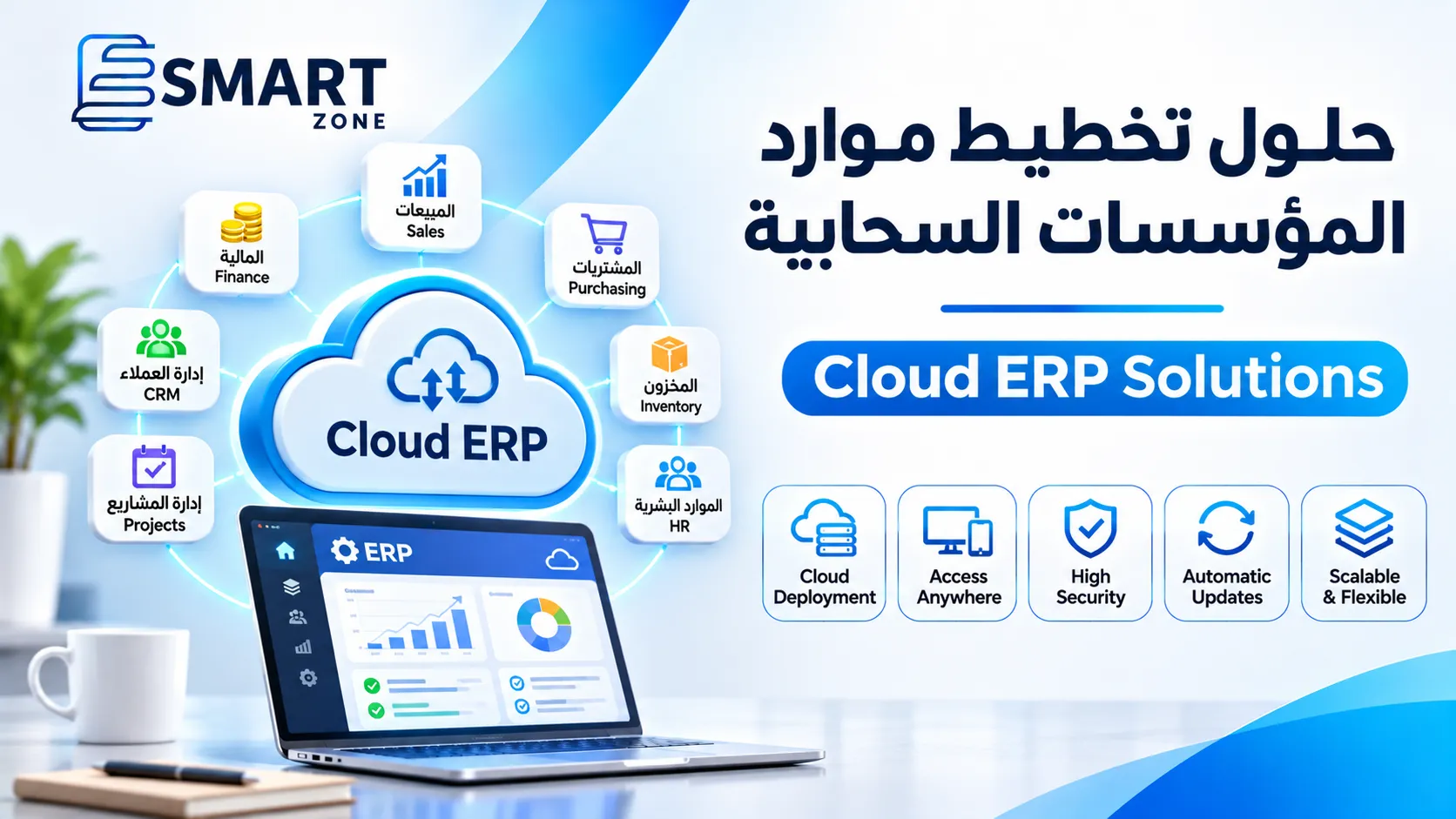
Smart Zone provides cloud ERP solutions in Jordan, helping businesses and organizations manage daily operations through centralized, cloud-hosted enterprise resource planning systems.
Modern organizations often need to coordinate sales, purchasing, inventory, human resources, and financial operations without relying on disconnected applications and spreadsheets.
Cloud ERP systems bring relevant business functions together within an integrated platform, enabling authorized users to access operational information online, manage approvals, review reports, and coordinate workflows across departments.
At Smart Zone, we analyze business requirements and help design, develop, configure, and implement suitable cloud ERP solutions using technologies such as PHP, Laravel, databases, and APIs, with attention to security, performance, and scalability.
We review organizational structure, departments, and existing processes to define required system functionality.
We plan application architecture, databases, services, and connectivity according to project requirements.
We develop tailored ERP systems when off-the-shelf platforms do not adequately address business needs.
We configure system modules, settings, permissions, and workflows according to the agreed scope.
We develop functionality for managing organizations, branches, and departments within the system.
We define user access based on responsibilities and authorized operations.
We implement functions for customer records, quotations, sales orders, and invoices.
We organize suppliers, purchase requests, purchase orders, receiving, and approvals.
We develop functionality for products, warehouses, quantities, and inventory movements.
We support inventory processes across multiple warehouses or branches where required.
We provide features for organizing customer records, transactions, and relevant communication history.
We develop functions for managing supplier information and related transactions.
We help configure or develop employee records, leave requests, and administrative workflows.
We develop agreed financial features in coordination with the organization's accounting specialists and applicable requirements.
We provide functions for creating invoices, tracking statuses, and linking them with relevant transactions.
We develop tools for recording, categorizing, and approving business expenses.
Optional modules can organize projects, assignments, responsibilities, and progress.
We implement forms and workflows for administrative and operational requests.
We configure multi-step approval processes according to organizational responsibilities.
We connect system events with suitable automated actions to reduce repetitive manual work.
We develop reports covering sales, purchasing, inventory, and other agreed functions.
We design dashboards presenting relevant operational indicators according to user permissions.
We configure secure web access for authorized system users.
We consider desktop, tablet, and mobile usability according to project requirements.
We develop APIs that connect suitable ERP functions with mobile applications.
We help exchange product, order, and inventory data with supported ecommerce systems.
We connect appropriate information and workflows between ERP and CRM platforms.
Supported payment providers can be integrated according to operational and technical requirements.
We develop connections with supported logistics, messaging, storage, and other services.
We help transfer data from legacy systems, Excel files, and databases according to an agreed migration plan.
We review information before and after migration to identify duplicates, errors, and inconsistencies.
We help define and implement suitable backup processes based on retention and recovery requirements.
We consider authentication, authorization, encrypted communication, and sensitive data protection.
We help configure monitoring for application availability, errors, resources, and important services.
We review database queries, loading behavior, and resource utilization to identify improvements.
We design systems with expected growth in users, data, and functionality in mind.
We test core workflows, functions, permissions, and integrations against approved requirements.
We provide suitable training or user guidance according to the project agreement.
We help prepare the system for production use and review launch requirements.
Maintenance, technical support, updates, and enhancements can be provided under an agreed service arrangement.
Cloud ERP is an enterprise resource planning system hosted on cloud infrastructure that brings business functions together in a platform accessible online to authorized users.
It helps organizations manage operations and information without depending entirely on disconnected tools.
Cloud ERP: Operates on cloud infrastructure and provides network-based access under configured security controls.
On-Premises ERP: Operates on locally hosted infrastructure managed by the organization or its technical provider.
The appropriate choice depends on operational needs, cost, privacy, connectivity, and infrastructure requirements.
Cloud ERP can help organizations centralize information, coordinate departments, organize workflows, and provide operational reporting.
Actual benefits depend on implementation quality, data readiness, user training, and alignment with business processes.
Sales processes can be connected with inventory, purchasing, and invoicing within the same system.
This can reduce duplicate data entry and improve operational visibility.
Cloud ERP systems can be designed for multiple branches or warehouses, with suitable access permissions, reports, and workflows.
Cloud ERP requires appropriate user management, access controls, backup processes, secure communication, and monitoring.
Security measures should reflect data sensitivity, organizational requirements, and hosting arrangements.
Laravel can be used to develop backend functionality, APIs, user management, business rules, and database operations for custom ERP systems.
We select an appropriate architecture after reviewing project requirements and scale.
Analyze business and departmental requirements.
Define ERP modules and project scope.
Design cloud architecture and databases.
Develop or configure required functionality.
Set up users and permissions.
Implement integrations and workflows.
Prepare and migrate business data.
Test operations, security, and performance.
Train users.
Deploy and support initial operations.
Provide maintenance and improvements as agreed.
Smart Zone combines custom software development using PHP and Laravel, database engineering, API integration, and business process analysis.
These capabilities help us create cloud ERP solutions aligned with operational requirements and designed for structured, maintainable business management.
Looking for cloud ERP solutions in Jordan to manage sales, inventory, procurement, human resources, and business operations?
Contact Smart Zone to discuss your organization's requirements and the most suitable cloud ERP approach.
© Smartzone is Proudly Owned by Smartzone Smartzone
