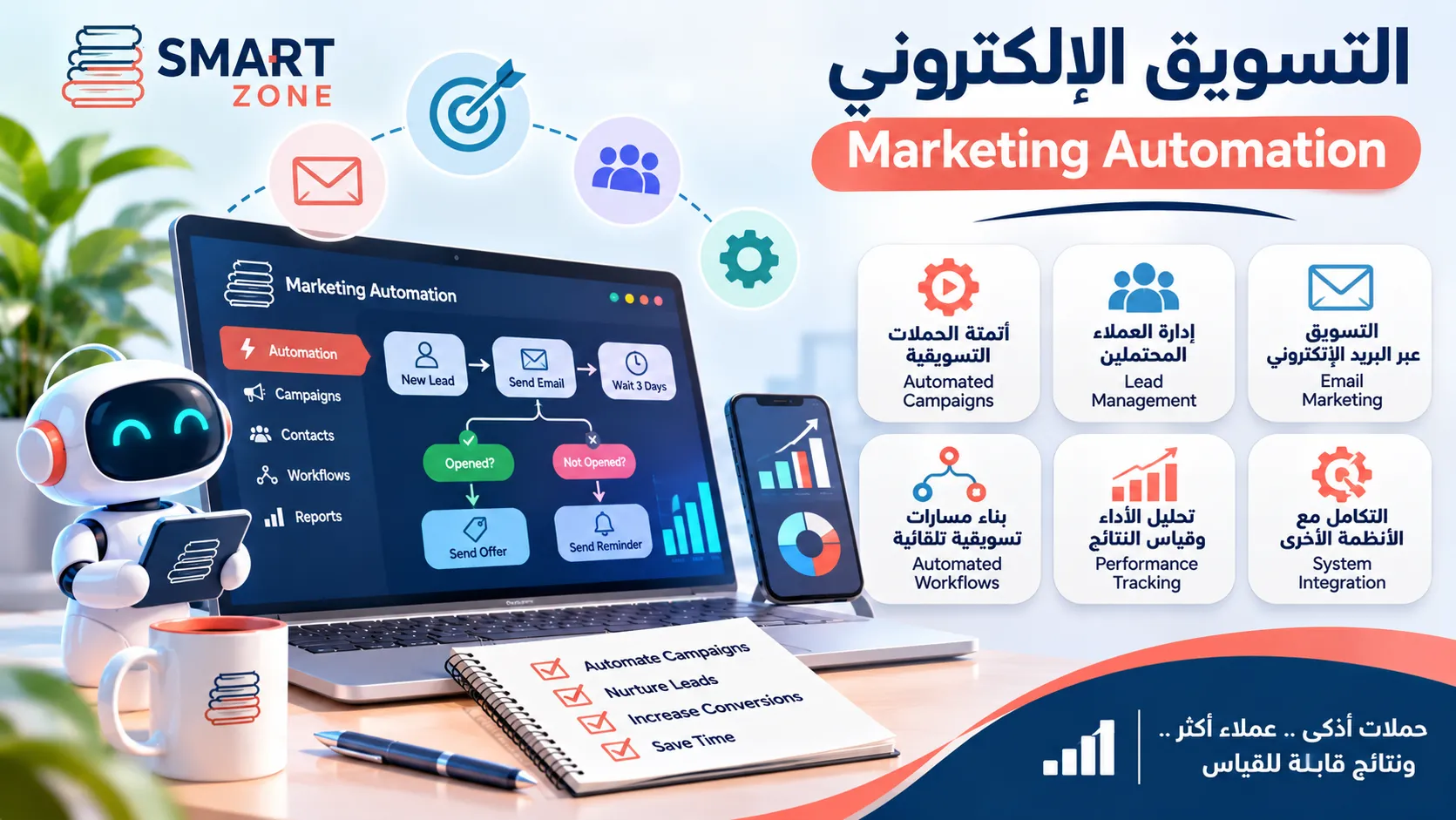
At Smart Zone, we provide marketing automation solutions in Jordan to help businesses organize marketing workflows, improve customer communication, manage leads, and reduce repetitive manual tasks through appropriate digital tools and integrations.
As businesses grow, manually managing every inquiry, follow-up message, campaign action, and customer interaction becomes increasingly demanding.
Marketing automation allows selected activities to be triggered by defined events, customer interactions, or information available within connected systems.
Our approach focuses on understanding the customer journey, identifying suitable automation opportunities, connecting marketing platforms with business applications, and developing workflows that support marketing and sales objectives.
We begin by reviewing how the business currently receives inquiries, manages leads, runs campaigns, and communicates with customers.
This helps identify repetitive activities that may benefit from automation, including lead assignment, follow-up notifications, status updates, and reporting tasks.
We help define an automation plan aligned with business objectives.
The strategy may focus on improving lead management, organizing campaign communication, supporting customer engagement, or reducing manual administrative work.
We identify relevant triggers, conditions, data requirements, communication channels, and performance indicators.
Automated email workflows can respond to events such as newsletter subscriptions, account registrations, service inquiries, or other approved customer actions.
Examples include welcome emails, follow-up sequences, educational content, and reminders.
Messaging workflows should respect applicable consent requirements and recipient preferences.
We help organize lead information and develop workflows that support timely internal follow-up.
Automated actions may include recording inquiries, assigning leads to team members, sending internal notifications, and updating statuses.
Connecting marketing tools with Customer Relationship Management systems can help organize contact records and customer interactions.
Depending on available APIs, automation may synchronize relevant information, update lead stages, and support coordination between marketing and sales teams.
Marketing platforms may allow businesses to organize audiences into groups based on appropriate characteristics, interests, or interactions.
We help evaluate segmentation options using available data and permitted processing methods.
Relevant segmentation can support more targeted communication.
We can help design workflows that reflect different stages of customer interaction.
A journey may begin with an inquiry and continue through information sharing, follow-up, or feedback requests.
Each workflow should include suitable timing, conditions, and stopping rules.
Where supported by an appropriate provider and permitted by platform policies, automated messaging can be connected to specific business events.
Examples may include inquiry acknowledgments, status updates, reminders, and approved follow-up communications.
Marketing messages and operational notifications may have different policy and consent requirements.
Online stores can use automation to support selected customer communication workflows.
Depending on the platform and applicable permissions, examples may include welcome sequences, order-related communication, and abandoned-cart reminders.
Contact forms, registration pages, and campaign landing pages can be integrated with CRM or automation tools.
This can reduce manual data entry and help route inquiries to the appropriate team.
We help assess integration opportunities between websites, applications, marketing platforms, and workflow automation services.
Depending on provider capabilities, these integrations may use APIs, webhooks, or supported automation connectors.
Automation can coordinate approved communication activities across email, notifications, and other supported channels.
The objective is to maintain organized customer communication while avoiding unnecessary duplication.
Some platforms allow messages to include relevant information such as a recipient's name, requested service, or customer journey stage.
We help identify appropriate personalization opportunities while considering data accuracy and privacy.
Relevant metrics may include message delivery, engagement, clicks, conversions, and lead status changes.
The available reporting capabilities and measurement accuracy depend on the platforms and tracking methods used.
Automation workflows require testing to verify triggers, conditions, timing, and integrations.
We help review workflow behavior, identify potential errors, and evaluate opportunities for improvement.
Marketing automation is the use of software and digital tools to execute selected marketing tasks automatically based on predefined rules, events, or customer interactions.
Examples include sending an approved welcome email after registration, notifying a sales team about a new inquiry, or updating a contact record when a specific event occurs.
Automation supports marketing operations but does not replace strategy, creativity, or human judgment.
Digital marketing includes activities such as paid advertising, search engine optimization, social media marketing, and content creation.
Marketing automation focuses on organizing and executing selected activities through automated workflows.
Marketing automation is therefore a supporting capability within a broader digital marketing strategy.
Well-designed automation can reduce repetitive work, improve the consistency of follow-up processes, and make selected customer interactions easier to manage.
It can also help teams organize lead information and monitor defined workflow outcomes.
Actual results depend on the quality of the data, workflow design, communication relevance, and overall marketing strategy.
Businesses do not always need complex automation platforms.
A practical starting point might involve connecting website forms to a CRM, sending inquiry acknowledgments, or notifying a sales representative when a new lead arrives.
Additional workflows can be introduced as requirements evolve.
Automated communication should respect recipient preferences, applicable privacy requirements, and platform messaging policies.
Businesses should manage consent where required, provide appropriate unsubscribe options, protect customer information, and avoid unsolicited messaging.
We begin by assessing existing marketing workflows and customer touchpoints.
We then identify automation opportunities, review suitable platforms, configure integrations, and test relevant scenarios.
After implementation, available performance information can help guide further adjustments.
We combine digital marketing knowledge with website development, application integration, and API experience.
This allows us to approach automation from both marketing and technical perspectives.
We focus on practical workflows, organized data, appropriate integrations, and solutions aligned with business objectives.
Looking for marketing automation services in Jordan, email automation, CRM integration, or automated lead follow-up solutions in Amman?
Contact Smart Zone to discuss your existing marketing processes and identify suitable automation opportunities.
© Smartzone is Proudly Owned by Smartzone Smartzone
