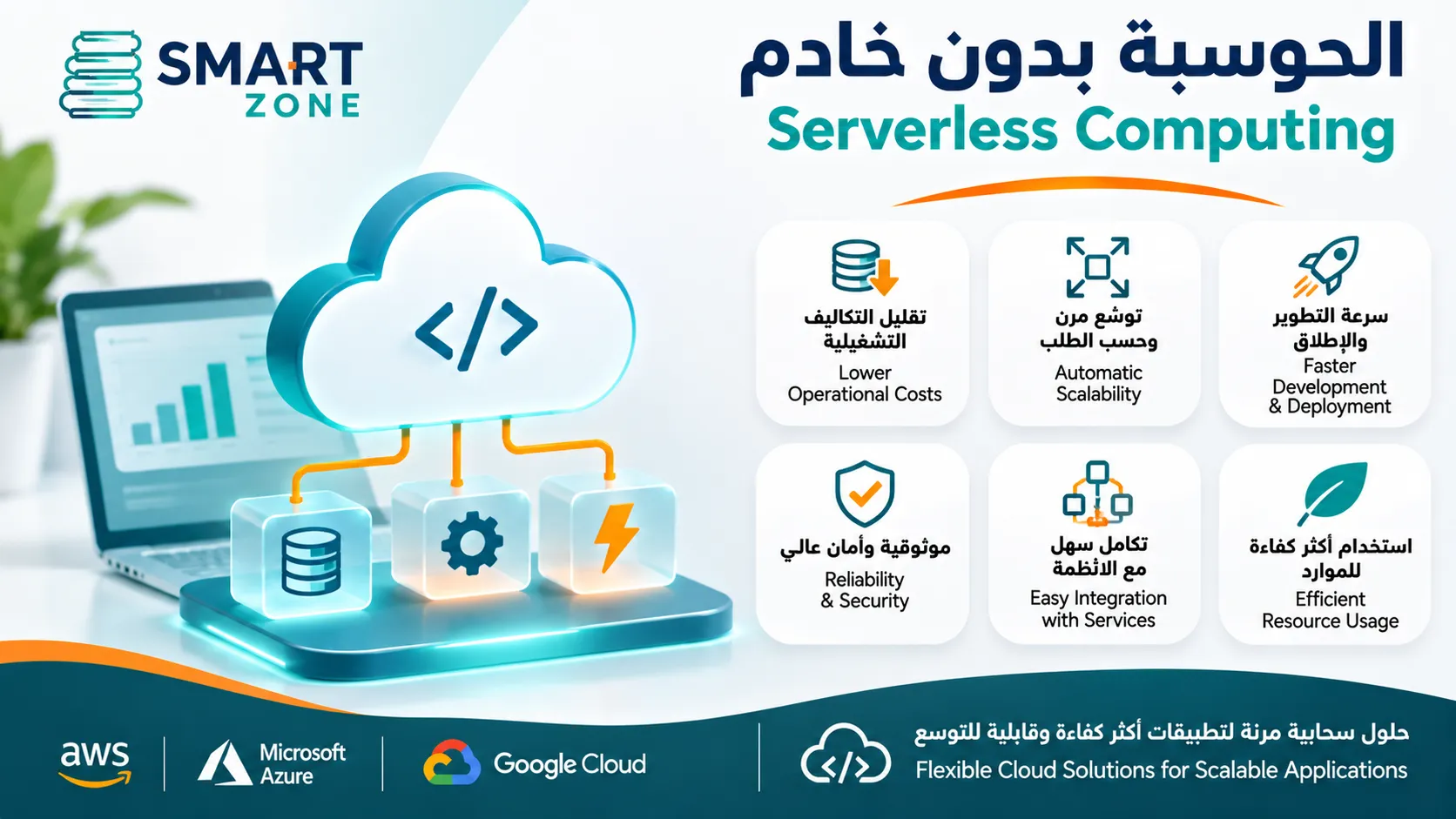
At Smart Zone, we provide serverless computing solutions in Jordan to help businesses build applications and digital services using cloud infrastructure that reduces the need for direct server management.
Serverless computing allows developers to focus more on application functionality while the cloud provider manages important aspects of the underlying infrastructure.
Despite its name, serverless computing still relies on physical servers. The difference is that businesses do not need to provision and manage those servers in the same way as traditional hosting environments.
Serverless technologies can support APIs, event-driven applications, background processing, scheduled tasks, data workflows, and integrations between business systems.
Our approach focuses on evaluating whether serverless architecture is appropriate, designing suitable components, developing cloud functions, and integrating them with existing applications.
We begin by reviewing the application's requirements, expected workloads, performance needs, and external integrations.
We help identify functions that may be suitable for serverless execution while considering cost, security, technical limitations, and operational requirements.
We help develop functions that execute in response to specific requests or events.
These functions can support data processing, background operations, notifications, and communication with other services.
APIs can be built using cloud functions triggered by incoming requests.
This approach can support selected backend capabilities without requiring the business to manage a conventional application server directly.
Event-driven systems respond to actions such as file uploads, new orders, or data changes.
We help design workflows that process these events and coordinate relevant services.
Serverless functions can execute repetitive or conditional business operations.
Examples include processing requests, updating records, and triggering defined workflows.
We consider error handling, retries, and reliable execution when designing these processes.
Cloud functions can be triggered when files are uploaded to supported storage services.
Depending on project requirements, processing may include file validation, image resizing, or other media-related operations.
Certain functions can run on a defined schedule.
Examples include generating reports, updating selected records, and executing maintenance-related application tasks.
Serverless functions can interact with supported databases to retrieve, update, or process information.
We review connection patterns, concurrency, and resource limits to help avoid unnecessary database load.
Serverless components can connect applications with external APIs, messaging platforms, storage services, and business tools.
These integrations can operate as separate functions without placing every process inside the main application.
Queue-based architectures can organize tasks that do not need to complete during an immediate user request.
We help design message processing with appropriate handling for failures, retries, and duplicate events.
Some applications benefit from independent services responsible for specific functions.
Serverless technologies may support this approach, although microservices are not necessary or appropriate for every project.
Serverless functions can be integrated with existing websites, applications, and Laravel-based backend systems.
This allows businesses to introduce serverless capabilities for selected workloads without necessarily migrating the entire application.
Some serverless services use pricing models based on requests, execution duration, and consumed resources.
We help evaluate usage patterns and potential cost implications.
Serverless computing is not automatically the least expensive option for every workload.
We consider least-privilege permissions, secure communication, secret management, and appropriate protection of sensitive information.
Security responsibilities remain shared between the business and its cloud provider.
Serverless applications require visibility into execution behavior, errors, duration, and resource consumption.
We help review suitable logging, monitoring, and alerting options using the available platform capabilities.
We help test functions and integrations and prepare appropriate deployment procedures.
Depending on the project, ongoing work may include configuration reviews, dependency updates, error investigation, and release management.
Serverless computing is a cloud execution model in which the provider manages significant parts of the infrastructure needed to run application code.
A common example is Functions as a Service (FaaS), where code runs in response to a request or event.
When a supported event occurs, the cloud platform invokes the associated function.
The platform allocates execution resources, processes the task, and returns or stores the result as required.
Resource allocation, billing, and execution limits vary by provider.
Serverless computing may reduce infrastructure administration, support automatic scaling for suitable workloads, and simplify the development of independent functions.
However, limitations may include execution timeouts, resource restrictions, platform dependencies, and cold-start latency.
Traditional hosting typically gives the business or its technical team greater responsibility for managing servers and runtime environments.
Serverless platforms manage additional infrastructure responsibilities.
The right approach depends on application behavior, cost considerations, operational requirements, and the level of control needed.
Serverless functions can complement Laravel applications by handling file processing, webhook events, scheduled tasks, and selected background operations.
A business does not necessarily need to migrate its entire Laravel application to a serverless architecture.
Serverless can be appropriate for event-driven processes, intermittent workloads, certain APIs, scheduled jobs, and system integrations.
Applications requiring long-running processes, persistent connections, or specialized infrastructure control may benefit from other hosting models or hybrid architectures.
We begin by assessing project requirements and existing systems.
Next, we identify suitable workloads, review architecture and integration options, evaluate security and cost considerations, and develop and test the required functions.
Deployment and operational monitoring are planned according to the agreed project scope.
We combine backend development, API integration, and cloud-related technical capabilities to evaluate serverless solutions within the broader application architecture.
Our focus is on maintainable implementations, practical integrations, appropriate security controls, and clear operational considerations.
Looking for serverless computing services in Jordan, cloud function development, event-driven applications, or serverless API integration in Amman?
Contact Smart Zone to discuss your project requirements and determine whether serverless architecture is a suitable approach.
© Smartzone is Proudly Owned by Smartzone Smartzone
