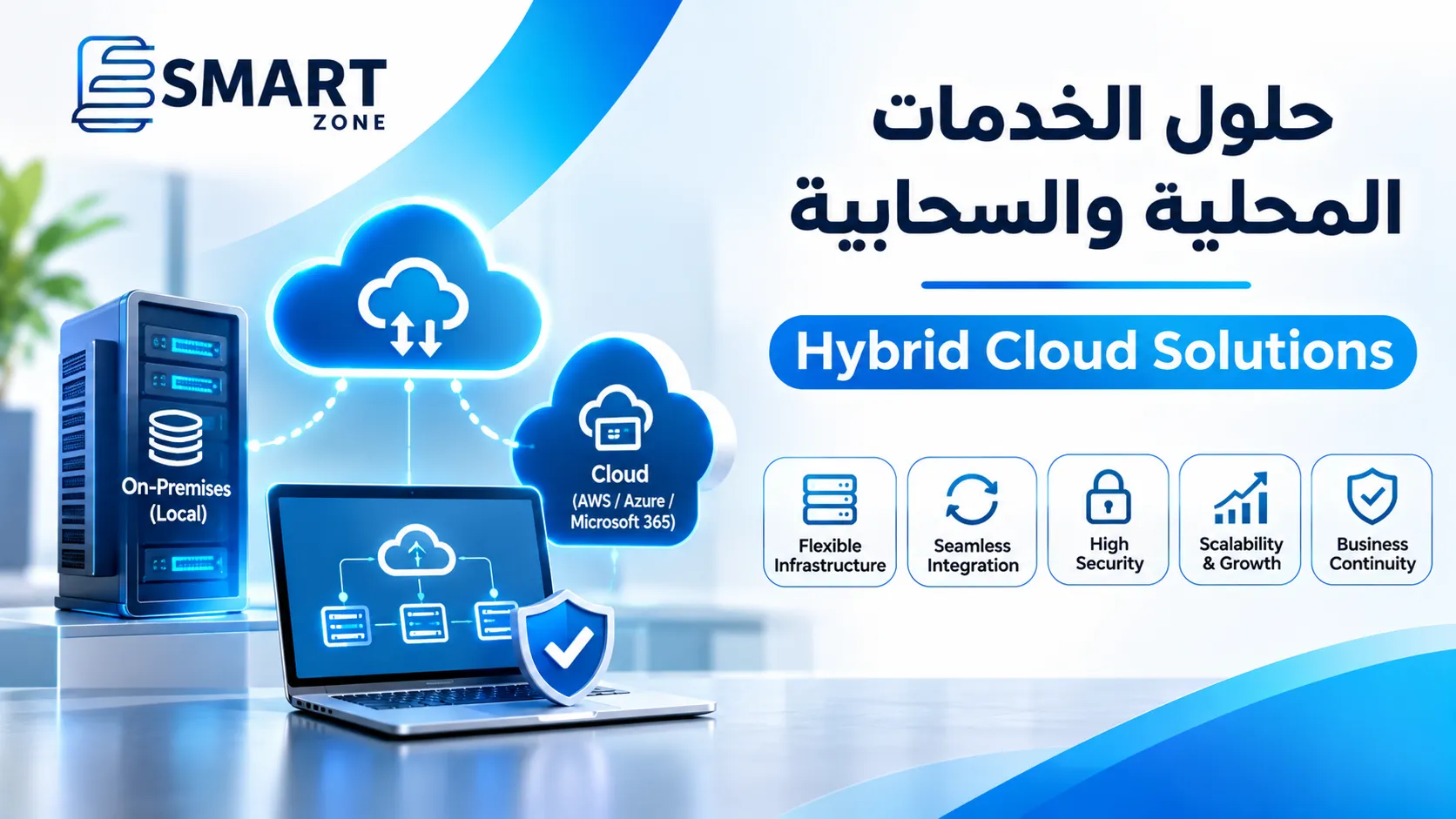
Smart Zone provides hybrid cloud solutions in Jordan, helping businesses and organizations connect on-premises infrastructure with cloud services through an integrated architecture aligned with operational and security requirements.
Some organizations need to retain specific applications or databases within their premises while using cloud services for other workloads, expansion, backups, or disaster recovery.
A hybrid cloud approach allows businesses to distribute applications, data, and workloads between local infrastructure and cloud environments according to performance, cost, privacy, and operational considerations.
At Smart Zone, we help assess existing systems, design integration approaches, connect on-premises and cloud environments, and support application migration, data synchronization, and monitoring according to the agreed project scope.
We review current servers, applications, databases, and connectivity to identify hybrid cloud requirements.
We evaluate application compatibility, network requirements, security considerations, and operational dependencies.
We define how applications, data, and services should be distributed between on-premises and cloud environments.
We help connect internal systems with suitable cloud-hosted services.
We plan appropriate connectivity between local and cloud networks, including supported encrypted or private connections.
We connect locally hosted applications with supported cloud applications and services.
We help migrate suitable applications after assessing compatibility, dependencies, and operational requirements.
We plan database migration between local and cloud environments while considering data integrity.
We develop suitable processes for exchanging and updating information between connected systems.
We help configure local and cloud backup processes according to retention and recovery requirements.
We support recovery planning for system or environment failures according to agreed recovery objectives.
We define suitable access controls for users, applications, and services.
We help connect authentication and user management services where supported.
We consider encrypted communication and appropriate authentication between connected environments.
We review suitable storage security, encryption, and access-control options according to data sensitivity.
We develop connections and services supporting data exchange between databases and applications across environments.
We help deploy or connect ERP components across local and cloud environments where technically appropriate.
We connect supported on-premises CRM systems with cloud services when required.
We help distribute application components between on-premises and cloud infrastructure according to technical requirements.
We develop and configure suitable connectivity between Laravel applications and local or cloud services.
We use APIs to connect applications and services through structured data exchange.
We help connect supported local and cloud storage solutions for files and documents.
We assess which applications and services are most appropriate for each environment.
We help design architectures that can accommodate additional resources as business requirements grow.
We review resource distribution to identify opportunities for improved efficiency.
We help assess resource usage and deployment options to identify unnecessary spending where possible.
We support suitable environments for developing and testing applications before production deployment.
We review application configuration, environment settings, and connection requirements across systems.
We help configure monitoring for applications, connectivity, resources, and relevant services.
We organize operational logs and error information to support troubleshooting.
We help coordinate application updates while considering dependencies between environments.
We test communication and required operations between local and cloud systems.
Recovery testing can be performed within the agreed scope to assess recovery readiness.
We help organize migration into manageable stages to reduce operational risks.
We document architecture components, connections, dependencies, and important settings according to project scope.
Technical support, monitoring, maintenance, and improvements can be provided under an agreed service arrangement.
Hybrid cloud combines on-premises technology resources with cloud services through connectivity or integration that allows them to operate as part of a coordinated environment.
It does not necessarily require moving every application or dataset to the cloud.
On-Premises: Systems and resources operate within an organization's local infrastructure.
Cloud: Resources and services are hosted by a cloud provider.
Hybrid Cloud: Local and cloud environments are combined and connected according to operational needs.
Organizations may need to retain legacy applications or certain datasets locally while using cloud services for expansion, new applications, or backup.
Hybrid cloud can provide flexibility in workload placement, but requires careful connectivity, security, and data management.
Some enterprise system components can operate locally while connecting to cloud services such as mobile applications, reporting tools, storage, or backups.
Feasibility depends on system architecture, integration capabilities, and business requirements.
Hybrid environments require clear access controls, secure connectivity, backup procedures, and monitoring.
Responsibilities should be defined between the organization, cloud providers, and technical operators.
We begin by reviewing existing applications, data, and dependencies, then identify which components can be migrated or connected to cloud services.
A phased transition and suitable testing help prepare the environment for production use.
Assess existing systems and infrastructure.
Define business and operational objectives.
Evaluate application and data readiness.
Design the hybrid architecture.
Define connectivity, access, and security requirements.
Configure required environments and services.
Implement agreed integrations and migrations.
Test connectivity, data exchange, and functionality.
Prepare monitoring and backup processes.
Document and deliver the solution.
Provide support and enhancements as agreed.
Smart Zone combines software development, database engineering, system integration, and web application expertise to support connections between on-premises systems and cloud services.
We focus on clear architecture, structured data exchange, phased transitions, and maintainability.
Looking for hybrid cloud solutions in Jordan to connect your on-premises servers with cloud services, migrate applications, or synchronize databases?
Contact Smart Zone to discuss your infrastructure and the hybrid cloud approach suitable for your organization.
© Smartzone is Proudly Owned by Smartzone Smartzone
