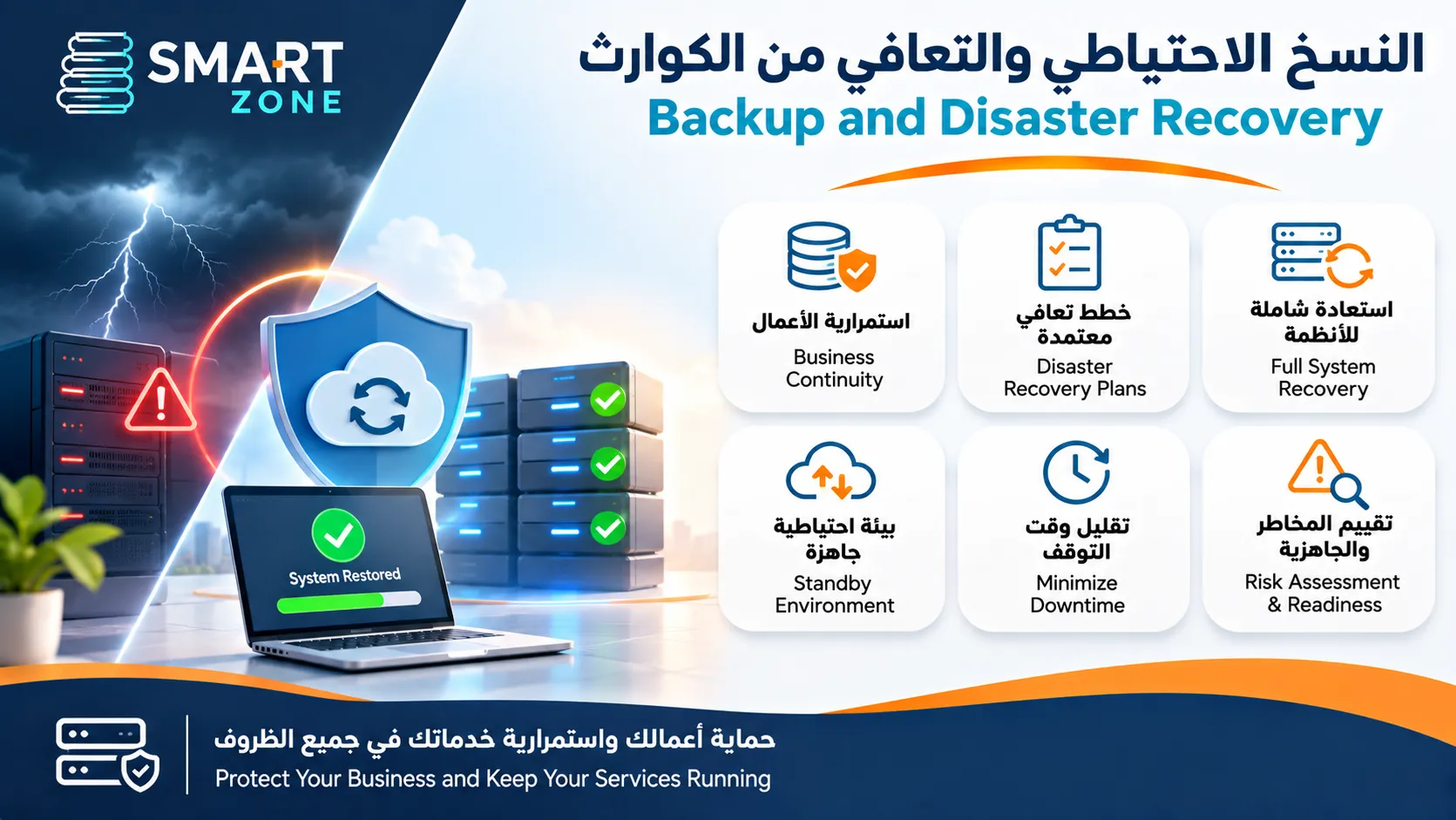
At Smart Zone, we provide backup and disaster recovery solutions in Jordan to help businesses prepare for major technical disruptions, protect critical systems, and organize the restoration of applications, infrastructure, and data.
Modern organizations rely on websites, mobile applications, databases, and cloud services to support daily operations.
A serious infrastructure failure, hosting outage, data corruption incident, or cyberattack can interrupt access to essential services and affect employees and customers.
Preparing for these situations requires more than creating backup files. Businesses need to identify critical systems, understand recovery dependencies, define responsibilities, and establish practical procedures for restoring services.
Our approach focuses on evaluating recovery requirements, reviewing existing infrastructure, and developing suitable recovery strategies aligned with operational priorities and available resources.
We begin by reviewing the systems and services on which the business depends.
Potential scenarios may include server failures, storage problems, hosting outages, connectivity disruptions, and operational errors.
This helps identify risks that require documented recovery procedures.
We help evaluate how the unavailability of different systems may affect business operations.
The findings support prioritization of critical applications and services during recovery.
We can help prepare recovery plans describing covered systems, possible disruption scenarios, responsibilities, and restoration procedures.
Plans should reflect the actual technical environment and be reviewed following significant changes.
Recovery Time Objective (RTO) represents the target duration for restoring a service after an interruption.
Recovery Point Objective (RPO) represents the target amount of data loss measured in time.
We help evaluate these objectives against business requirements, technical capabilities, and cost considerations.
Objectives should not be presented as guaranteed results without validation and an appropriate agreement.
We help identify the data, configurations, and system components required to support restoration.
This may include databases, application files, uploaded documents, and relevant operational settings.
Separating backup copies from the production environment can reduce exposure to common failures.
We help evaluate appropriate storage locations and services based on security, availability, and cost requirements.
Recovery may require rebuilding an operating environment, redeploying an application, or restoring server configurations.
We help document and implement appropriate procedures within the supported infrastructure and agreed scope.
Restoring a server alone does not mean the application is fully operational.
We help plan the sequence for restoring databases, application files, and connected services, followed by relevant functional verification.
Hosting disruptions can affect websites and applications.
We help evaluate restoration or redeployment options based on available backups, infrastructure requirements, and access permissions.
Cloud services may provide storage, recovery resources, and alternative environments for selected workloads.
Available capabilities depend on the provider, architecture, and project budget.
Some applications may benefit from transferring workloads to alternative infrastructure when primary resources fail.
We help assess whether failover is appropriate and review requirements involving synchronization, testing, and operating costs.
Applications may depend on databases, authentication services, storage, messaging providers, or external APIs.
We help identify these dependencies and establish a suitable restoration order.
Recovery planning can include initial procedures for identifying an incident, assessing its impact, and assigning responsibilities.
For security incidents, restoration should be coordinated with appropriate containment and investigation activities.
Malware, unauthorized access, and other security incidents may affect systems or data.
We help evaluate technical restoration options using appropriate backups, while emphasizing the need to verify the environment before returning services to operation.
A documented plan may contain gaps that only become visible during testing.
We help plan suitable exercises to evaluate recovery steps, dependencies, required resources, and estimated restoration times.
Recovery exercises may examine scenarios such as server outages, database loss, or unavailable storage services.
These exercises help identify weaknesses and improve recovery documentation.
Recovery procedures depend on available backups, necessary credentials, and access to required infrastructure.
We help review suitable monitoring and verification options using supported tools.
We help prepare operational instructions describing restoration steps, technical prerequisites, and responsible personnel.
Recovery documentation should remain securely accessible even when the primary system is unavailable.
Disaster recovery may require communication with hosting, storage, network, or external service providers.
We can help organize relevant technical information and clarify responsibilities between the involved parties.
Infrastructure and application changes can affect existing recovery procedures.
Periodic reviews help determine whether recovery plans remain suitable for the current environment.
Disaster recovery is the process of preparing for and restoring technology services following major disruptions.
It includes identifying critical systems, arranging suitable recovery resources, documenting procedures, and testing restoration capabilities.
Data backup focuses on preserving copies of information for future restoration.
Disaster recovery covers restoring applications, databases, servers, connectivity, and related services after a serious interruption.
Backups are often essential to recovery, but they do not independently guarantee that a system can resume operation.
RTO and RPO help organizations define acceptable recovery targets.
Shorter recovery targets may require additional infrastructure, more frequent replication, and higher operating costs.
The appropriate objectives depend on business priorities and technical feasibility.
Cloud platforms provide different options for backup storage, recovery environments, and infrastructure deployment.
However, cloud hosting does not automatically protect applications from every failure.
Architecture, configuration, permissions, and recovery testing remain important.
Recovering a Laravel application may involve restoring its runtime environment, application code, database, uploaded files, background services, and external integrations.
Documenting these components helps establish a repeatable restoration process.
Disaster recovery focuses on restoring technology systems.
Business continuity has a broader scope and includes operational arrangements that allow an organization to continue essential activities during and after disruptions.
We begin by identifying critical systems and assessing potential disruption scenarios.
Next, we review existing backups, technical dependencies, available resources, and recovery requirements.
We then help define suitable recovery objectives, document procedures, and plan testing and future reviews according to the agreed scope.
We combine application development, backend engineering, database knowledge, and cloud-related technical capabilities.
This helps us assess disaster recovery requirements within the actual system architecture.
Our focus is on clear recovery procedures, appropriate data protection, practical testing, and defined responsibilities.
Looking for backup and disaster recovery services in Jordan, disaster recovery planning, cloud recovery options, or application restoration support in Amman?
Contact Smart Zone to discuss your critical systems, recovery priorities, and operational requirements.
© Smartzone is Proudly Owned by Smartzone Smartzone
